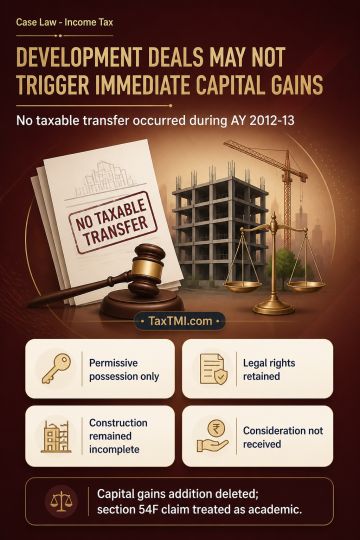
Development agreements require legal possession or effective enjoyment for capital gains transfer; permissive possession and deferred consideration de...
Prolonged sterilisation of development rights supports capital-gains treatment, while business-income disallowances cannot govern capital-gains comput...
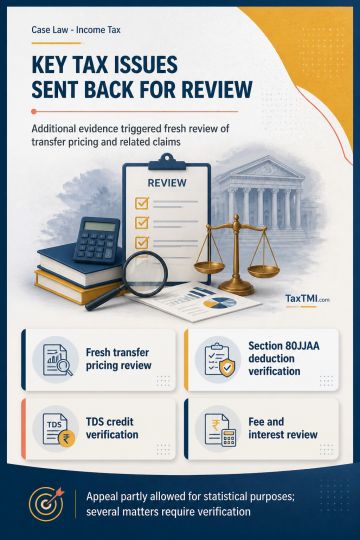
Additional evidence in transfer pricing dispute leads to fresh examination, while tax deductions, TDS credit, fee and refund interest require verifica...
Category II AIF pass-through taxation preserves non-business income character; investment receipts cannot be reclassified without applying recognised ...
HC held that Section 39(5) of the Companies Act must be applied...
Proportionality in company penalty quantification requires aggravating and mitigating factors; mechanical multiplication of director liability is impermissible.
Contents
Summary
Note
Bookmark
Share
✓ Copied successfully !
Print
Print Options
For full text, please login
Login to TaxTMI
Verification Pending
The Email Id has not been verified. Click on the link we have sent on
HC held that Section 39(5) of the Companies Act must be applied with proportionality, so penalty quantification cannot be reduced to a mechanical daily computation; aggravating and mitigating circumstances must be considered under Rule 3(12), and the impugned order was arbitrary in treating the provision as fixed and mandatory. The Court also held that non-certification of the list of allottees separately with Form PAS-3 remained a technical default attracting liability, although the affirmation in the form mitigated its gravity. On officer liability, the penalty could not be mechanically multiplied by the number of directors; it was modified to joint and several liability against the company and its directors.
HC held that Section 39(5) of the Companies Act must be applied with proportionality, so penalty quantification cannot be reduced to a mechanical daily computation; aggravating and mitigating circumstances must be considered under Rule 3(12), and the impugned order was arbitrary in treating the provision as fixed and mandatory. The Court also held that non-certification of the list of allottees separately with Form PAS-3 remained a technical default attracting liability, although the affirmation in the form mitigated its gravity. On officer liability, the penalty could not be mechanically multiplied by the number of directors; it was modified to joint and several liability against the company and its directors.
Note: It is a system-generated summary and is for quick reference only.
 TaxTMI
 of 4805










 Join Channel


 TaxTMI
