Necessary-party requirements limit impleadment of independent entities, while deferred consideration does not create an appealable adverse determinati...
Food supplement classification requires common parlance and authoritative tests, preventing treatment as proprietary Ayurvedic medicines without suppo...
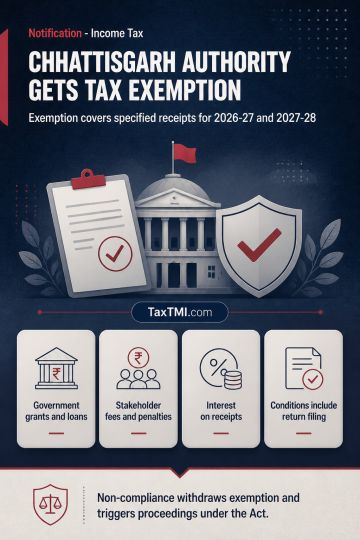
Specified regulatory authority income receives conditional tax exemption, subject to non-commercial activity, unchanged income character, and return f...
Tax exemption for regulatory authority income applies retrospectively, subject to non-commercial activity, unchanged income sources, and return-filing...
Input tax credit conditions remain constitutionally valid, with eligible recipient claims considered under GST circulars and retrospective filing dead...
Page of 4809
Press 'Enter' after typing page number.
861 to 880 of 96174 Results
❮
❯
❯❯
0 / 200
Expand Note
Add to Folder
No Folders have been created
+
Are you sure you want to delete "My most important" ?
HC held that Section 39(5) of the Companies Act must be applied...
Proportionality in company penalty quantification requires aggravating and mitigating factors; mechanical multiplication of director liability is impermissible.
Contents
Summary
Note
Bookmark
Share
✓ Copied successfully !
Print
Print Options
For full text, please login
Login to TaxTMI
Verification Pending
The Email Id has not been verified. Click on the link we have sent on
HC held that Section 39(5) of the Companies Act must be applied with proportionality, so penalty quantification cannot be reduced to a mechanical daily computation; aggravating and mitigating circumstances must be considered under Rule 3(12), and the impugned order was arbitrary in treating the provision as fixed and mandatory. The Court also held that non-certification of the list of allottees separately with Form PAS-3 remained a technical default attracting liability, although the affirmation in the form mitigated its gravity. On officer liability, the penalty could not be mechanically multiplied by the number of directors; it was modified to joint and several liability against the company and its directors.
HC held that Section 39(5) of the Companies Act must be applied with proportionality, so penalty quantification cannot be reduced to a mechanical daily computation; aggravating and mitigating circumstances must be considered under Rule 3(12), and the impugned order was arbitrary in treating the provision as fixed and mandatory. The Court also held that non-certification of the list of allottees separately with Form PAS-3 remained a technical default attracting liability, although the affirmation in the form mitigated its gravity. On officer liability, the penalty could not be mechanically multiplied by the number of directors; it was modified to joint and several liability against the company and its directors.
Note: It is a system-generated summary and is for quick reference only.
 TaxTMI
  TaxTMI
 of 4809
















 Join Channel




