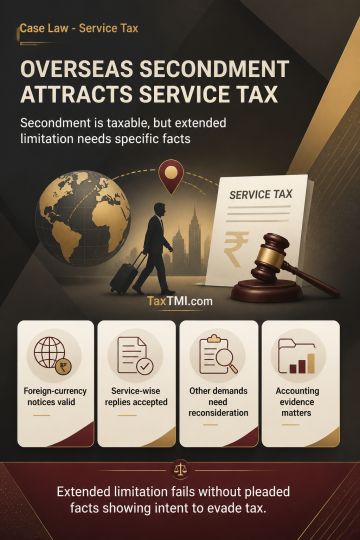
Extended limitation fails without specific suppression allegations, while overseas employee secondment remains taxable as manpower supply within norma...
Time-share accommodation classification excludes Club or Association Service where purchasers receive contractual occupancy rights without genuine mem...
CENVAT credit for trading requires reversal, while taxable-service rental credit remains proportionately available and limitation issues await resolut...
Vicarious liability for dishonoured company cheques may extend to non-signatory directors where complaints contain foundational responsibility avermen...
Arbitral awards on prolongation costs, GST reimbursement, minimum-wage escalation, Environmental Compensation Charges and taxes were upheld under Section 34 because the tribunal had adopted a plausible view on the contract, delay attribution and quantification of damages. The court treated the prolongation-cost methodology as a permissible estimate based on record and industry practice, and refused re-appreciation of evidence. It also sustained reimbursement for GST introduced during the extended period, held that a minimum-wage escalation bar could not defeat compensation for employer-caused delay, and accepted ECC as an additional charge not clearly barred by the exclusion clause. The majority award was treated as binding, and no patent illegality or perversity was shown.
Arbitral awards on prolongation costs, GST reimbursement, minimum-wage escalation, Environmental Compensation Charges and taxes were upheld under Section 34 because the tribunal had adopted a plausible view on the contract, delay attribution and quantification of damages. The court treated the prolongation-cost methodology as a permissible estimate based on record and industry practice, and refused re-appreciation of evidence. It also sustained reimbursement for GST introduced during the extended period, held that a minimum-wage escalation bar could not defeat compensation for employer-caused delay, and accepted ECC as an additional charge not clearly barred by the exclusion clause. The majority award was treated as binding, and no patent illegality or perversity was shown.
Note: It is a system-generated summary and is for quick reference only.
 TaxTMI
  TaxTMI
 of 4814








 Join Channel