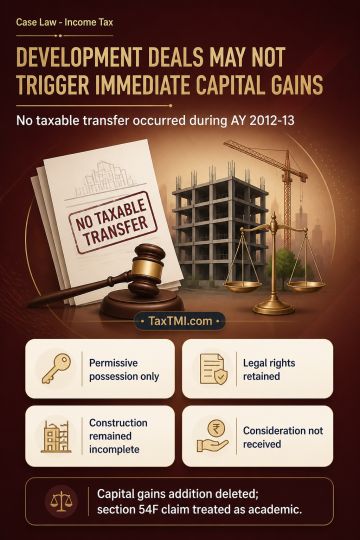
Development agreements require legal possession or effective enjoyment for capital gains transfer; permissive possession and deferred consideration de...
Prolonged sterilisation of development rights supports capital-gains treatment, while business-income disallowances cannot govern capital-gains comput...
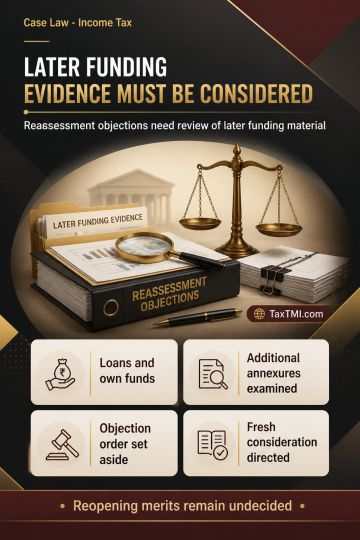
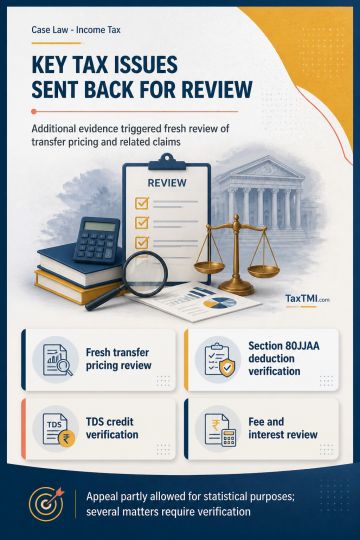
Additional evidence in transfer pricing dispute leads to fresh examination, while tax deductions, TDS credit, fee and refund interest require verifica...
Category II AIF pass-through taxation preserves non-business income character; investment receipts cannot be reclassified without applying recognised ...
Adjudication under Sections 73 and 74 is dispute-based and is...
Composite GST notices, mandatory limitation, and same-subject bar: HC upheld valid notices but quashed overlapping proceedings and unauthorised withholding.
Contents
Summary
Note
Bookmark
Share
✓ Copied successfully !
Print
Print Options
For full text, please login
Login to TaxTMI
Verification Pending
The Email Id has not been verified. Click on the link we have sent on
Adjudication under Sections 73 and 74 is dispute-based and is not confined to a single financial year or tax period; a composite notice may validly cover multiple periods, and under Section 74 may include multiple noticees, subject to objections in individual proceedings. However, Section 6(2)(b) bars parallel proceedings on the same subject-matter once formal adjudication has begun, so overlapping proceedings were held unsustainable. The statutory timelines for issuing notice and passing the adjudication order were treated as mandatory, making notices issued without the prescribed lead time time-barred. One notice could not support separate orders by different authorities absent lawful transfer, and a direction to withhold payment was set aside for lack of statutory authority.
Adjudication under Sections 73 and 74 is dispute-based and is not confined to a single financial year or tax period; a composite notice may validly cover multiple periods, and under Section 74 may include multiple noticees, subject to objections in individual proceedings. However, Section 6(2)(b) bars parallel proceedings on the same subject-matter once formal adjudication has begun, so overlapping proceedings were held unsustainable. The statutory timelines for issuing notice and passing the adjudication order were treated as mandatory, making notices issued without the prescribed lead time time-barred. One notice could not support separate orders by different authorities absent lawful transfer, and a direction to withhold payment was set aside for lack of statutory authority.
Note: It is a system-generated summary and is for quick reference only.
 TaxTMI
  TaxTMI
 of 4807

















 Join Channel


