Specific customs headings for scaffolding components prevail over general classification, invalidating misclassification proceedings and enabling with...
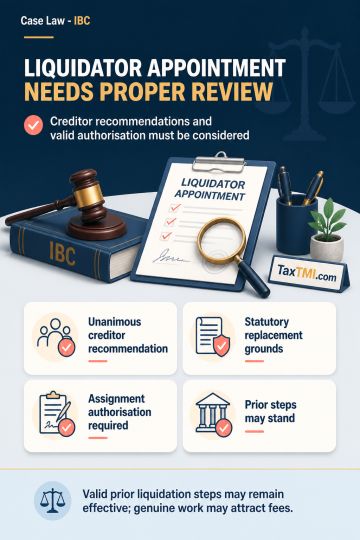
Liquidator appointment under Section 34 requires consideration of creditor recommendations, valid professional authorisation, and preservation of vali...
Income-tax exemption for specified regulatory fees and government grants applies subject to non-commercial activity and continuing compliance conditio...
Digital accessibility audit and remediation deadlines extended, while all other disability-compliance obligations for regulated entities remain unchan...
In a penalty matter under section 271D, the ITAT held that limitation under section 275(1)(c) runs from the Assessing Officer's reference initiating penalty action, not from the later notice issued by the Additional Commissioner. After noting conflicting High Court views, it followed the later Karnataka High Court position and also applied the principle that, where two non-jurisdictional interpretations are possible, the one favourable to the assessee must be adopted. As the penalty order was passed beyond the permissible period from the date of initiation, the penalty was time-barred and was quashed.
In a penalty matter under section 271D, the ITAT held that limitation under section 275(1)(c) runs from the Assessing Officer's reference initiating penalty action, not from the later notice issued by the Additional Commissioner. After noting conflicting High Court views, it followed the later Karnataka High Court position and also applied the principle that, where two non-jurisdictional interpretations are possible, the one favourable to the assessee must be adopted. As the penalty order was passed beyond the permissible period from the date of initiation, the penalty was time-barred and was quashed.
Note: It is a system-generated summary and is for quick reference only.
 TaxTMI
  TaxTMI
 of 4814

















 Join Channel