Service permanent establishment requires non-auxiliary services, while arm's-length distributor remuneration precludes further profit attribution in I...
Make-available condition excludes standard SaaS subscription receipts where customers receive no independently usable technical knowledge after subscr...
Anonymous donation classification fails where charitable trusts maintain undisputed donor identity records and evidence corpus contributions' intended...
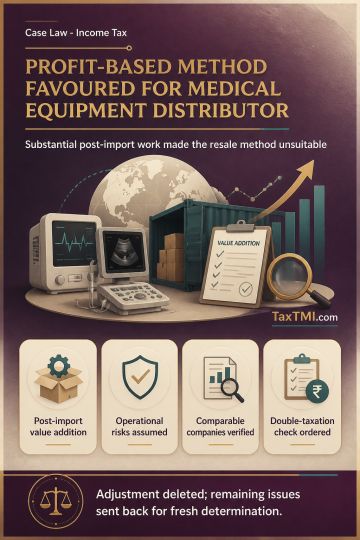
Transfer pricing method selection favours TNMM where medical-equipment distribution involves substantial post-import value addition and operational ri...
In a penalty matter under section 271D, the ITAT held that limitation under section 275(1)(c) runs from the Assessing Officer's reference initiating penalty action, not from the later notice issued by the Additional Commissioner. After noting conflicting High Court views, it followed the later Karnataka High Court position and also applied the principle that, where two non-jurisdictional interpretations are possible, the one favourable to the assessee must be adopted. As the penalty order was passed beyond the permissible period from the date of initiation, the penalty was time-barred and was quashed.
In a penalty matter under section 271D, the ITAT held that limitation under section 275(1)(c) runs from the Assessing Officer's reference initiating penalty action, not from the later notice issued by the Additional Commissioner. After noting conflicting High Court views, it followed the later Karnataka High Court position and also applied the principle that, where two non-jurisdictional interpretations are possible, the one favourable to the assessee must be adopted. As the penalty order was passed beyond the permissible period from the date of initiation, the penalty was time-barred and was quashed.
Note: It is a system-generated summary and is for quick reference only.
 TaxTMI
  TaxTMI
 of 4817




















 Join Channel


