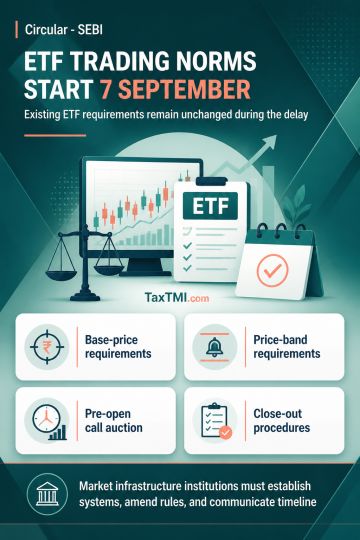
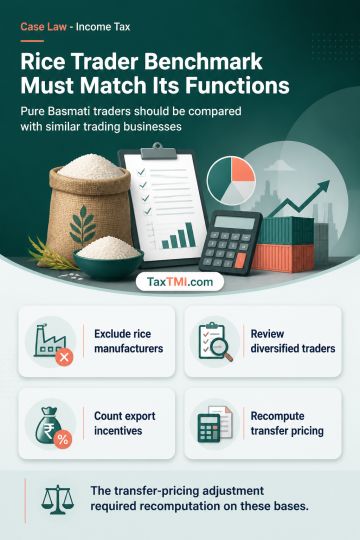
TNMM functional comparability requires excluding rice manufacturers from a pure Basmati rice trader's benchmark and recognising operating export recei...
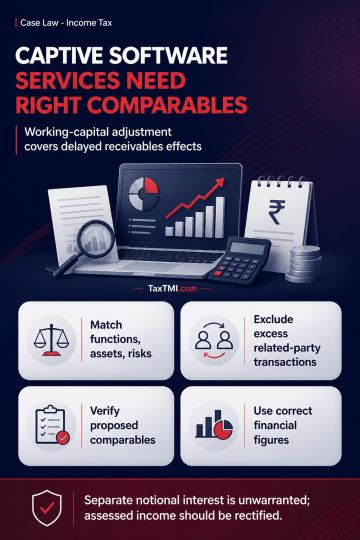
Working-capital adjustment subsumes delayed-receivable effects in TNMM benchmarking of captive software-development services, avoiding separate notion...
Transfer-pricing comparability requires exclusion of financially illogical super-profit comparables and correction of unsupported annual-report and ma...
Charitable character assessment preserves Section 80G approval despite inclusive spiritual teachings and incidental religious expenditure within the s...
Penalty proceedings for cash-loan acceptance require assessment proceedings and recorded Assessing Officer satisfaction; absent these, the proceedings...
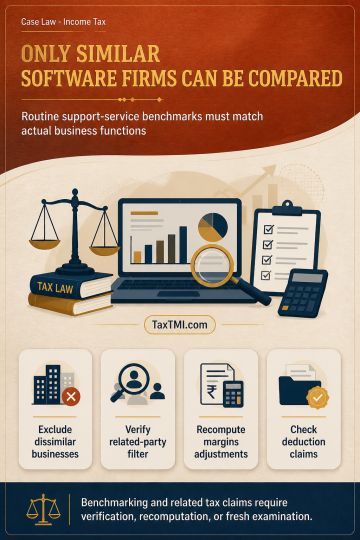
Functional comparability governs software-service benchmarking: dissimilar companies are excluded, while related-party filters, margins and working-ca...
Under the India-Germany DTAA, royalty and fees for technical services were taxable only on receipt basis because Article 12 uses the expressions "paid" and "payments received," so accrual-based taxation was rejected. Receipts from standard software supplied on non-exclusive, non-transferable terms were not royalty, as they did not involve use of copyright. The consortium arrangement did not create an association of persons because the parties had separate scopes, invoices, and consideration, with no joint management or profit sharing. Offshore supply profits were not taxable in India in the absence of a PE and in light of the treaty protocol. An ad hoc transfer pricing mark-up was unsustainable without proper arm's length benchmarking. Interest on the arbitration award was also held not taxable.
Under the India-Germany DTAA, royalty and fees for technical services were taxable only on receipt basis because Article 12 uses the expressions "paid" and "payments received," so accrual-based taxation was rejected. Receipts from standard software supplied on non-exclusive, non-transferable terms were not royalty, as they did not involve use of copyright. The consortium arrangement did not create an association of persons because the parties had separate scopes, invoices, and consideration, with no joint management or profit sharing. Offshore supply profits were not taxable in India in the absence of a PE and in light of the treaty protocol. An ad hoc transfer pricing mark-up was unsustainable without proper arm's length benchmarking. Interest on the arbitration award was also held not taxable.
Note: It is a system-generated summary and is for quick reference only.
 TaxTMI
  TaxTMI
 of 4824







 Join Channel