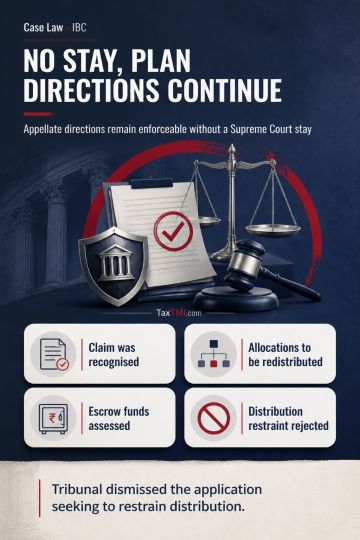
Enforcement of resolution-plan directions continues without a Supreme Court stay, preventing suspension of redistribution and escrowed-fund distributi...
Third-party ownership claims over attached property require Special Court adjudication where purchasers lack registered sale deeds and bona fides rema...
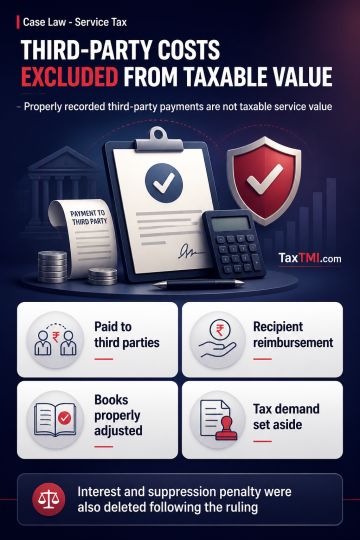
Pure-agent reimbursements in clearing and forwarding services are excluded from taxable value when qualifying third-party payments are properly record...
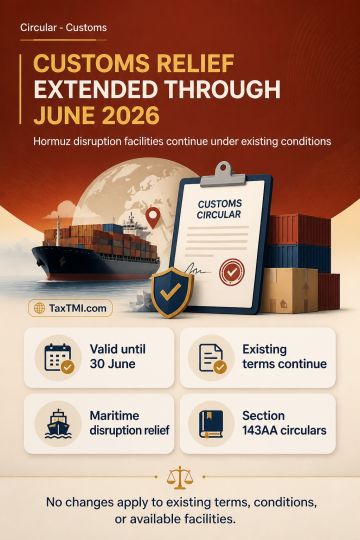
Customs relief for Strait of Hormuz maritime disruptions remains available, with existing conditions continuing unchanged through the extended validit...
Section 7 of the Insolvency and Bankruptcy Code requires the existence of a financial debt and default, but the Supreme Court held that insolvency cannot be used as a coercive recovery tool. Reading the quadripartite agreement, the Court found that the disbursement was made to the builder and was tied to construction, transfer, refund contingencies, non-transfer without consent, and security creation, making the dispute predominantly contractual rather than a simple lending default. As recovery proceedings were already pending before the DRT, initiation of CIRP was unwarranted and the refusal to admit the Section 7 application was upheld.
Section 7 of the Insolvency and Bankruptcy Code requires the existence of a financial debt and default, but the Supreme Court held that insolvency cannot be used as a coercive recovery tool. Reading the quadripartite agreement, the Court found that the disbursement was made to the builder and was tied to construction, transfer, refund contingencies, non-transfer without consent, and security creation, making the dispute predominantly contractual rather than a simple lending default. As recovery proceedings were already pending before the DRT, initiation of CIRP was unwarranted and the refusal to admit the Section 7 application was upheld.
Note: It is a system-generated summary and is for quick reference only.
 TaxTMI
  TaxTMI
 of 4814







 Join Channel