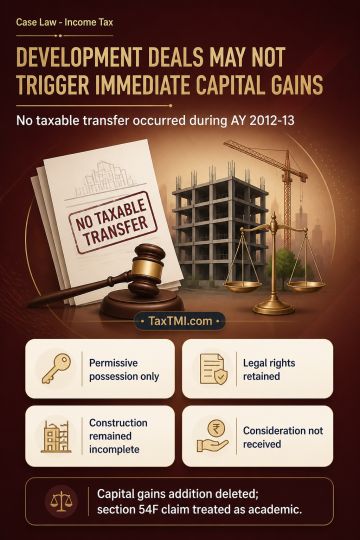
Development agreements require legal possession or effective enjoyment for capital gains transfer; permissive possession and deferred consideration de...
Prolonged sterilisation of development rights supports capital-gains treatment, while business-income disallowances cannot govern capital-gains comput...
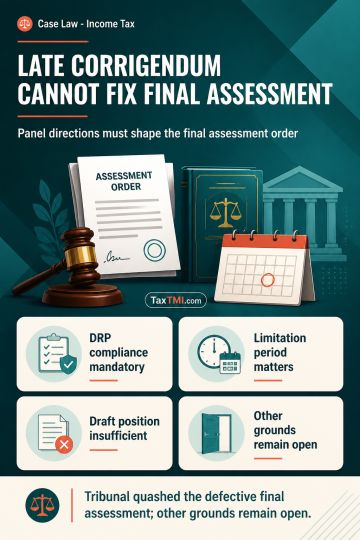
Additional evidence in transfer pricing dispute leads to fresh examination, while tax deductions, TDS credit, fee and refund interest require verifica...
Category II AIF pass-through taxation preserves non-business income character; investment receipts cannot be reclassified without applying recognised ...
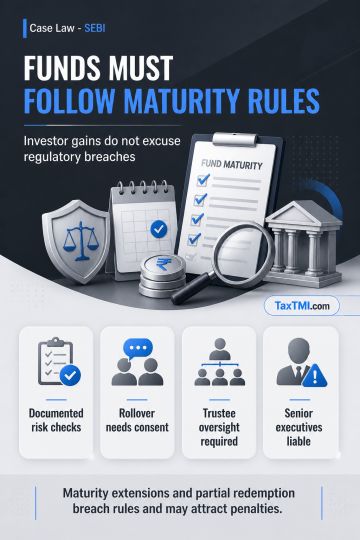
Mutual fund maturity rules require proper rollover, redemption, disclosure, and due diligence; investor gains cannot excuse regulatory breaches or pen...
Page of 4809
Press 'Enter' after typing page number.
1381 to 1400 of 96177 Results
❮
❯
❯❯
0 / 200
Expand Note
Add to Folder
No Folders have been created
+
Are you sure you want to delete "My most important" ?
A pre-existing dispute barred admission of the Section 9 operational debt claim where contemporaneous grievances over water supply, central air-conditioning, maintenance, and interference with use of the premises had been raised before the demand notice and were supported by proceedings seeking restoration of services and police assistance. Applying the Mobilox standard, the Tribunal treated the defence as a plausible contention requiring further investigation rather than a sham or moonshine defence. It therefore held that liability for charges claimed after the corporate debtor entered CIRP was genuinely disputed, affirmed rejection of the Section 9 petition, and dismissed the appeal.
A pre-existing dispute barred admission of the Section 9 operational debt claim where contemporaneous grievances over water supply, central air-conditioning, maintenance, and interference with use of the premises had been raised before the demand notice and were supported by proceedings seeking restoration of services and police assistance. Applying the Mobilox standard, the Tribunal treated the defence as a plausible contention requiring further investigation rather than a sham or moonshine defence. It therefore held that liability for charges claimed after the corporate debtor entered CIRP was genuinely disputed, affirmed rejection of the Section 9 petition, and dismissed the appeal.
Note: It is a system-generated summary and is for quick reference only.
 TaxTMI
  TaxTMI
 of 4809














 Join Channel