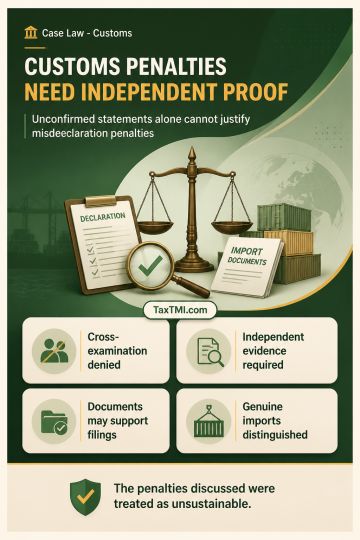
Cross-examination rights and corroborated evidence limit customs penalties for misdeclaration in genuine import transactions involving documented clea...
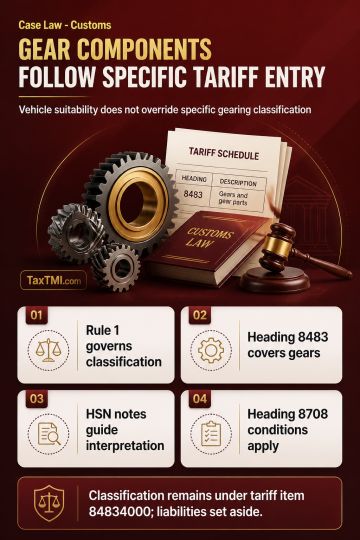
Tariff classification of vehicle gear components follows the specific gearing entry, displacing motor-vehicle parts classification and related liabili...
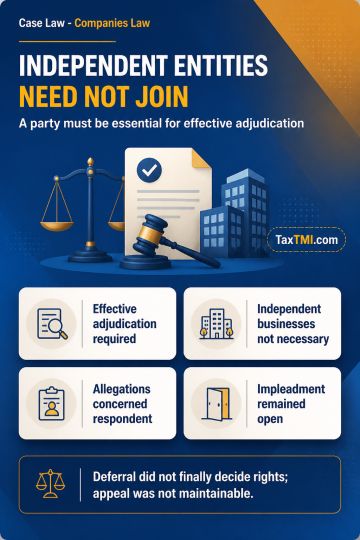
Necessary-party requirements limit impleadment of independent entities, while deferred consideration does not create an appealable adverse determinati...
Food supplement classification requires common parlance and authoritative tests, preventing treatment as proprietary Ayurvedic medicines without suppo...
Specified regulatory authority income receives conditional tax exemption, subject to non-commercial activity, unchanged income character, and return f...
Tax exemption for regulatory authority income applies retrospectively, subject to non-commercial activity, unchanged income sources, and return-filing...
Regulated entities in the securities market are advised to strengthen cyber resilience against AI-driven vulnerability detection tools by updating systems and applications promptly, using virtual patching where needed, and conducting regular vulnerability assessments, security audits, and scenario-based risk assessments. They should coordinate with third-party vendors to release and deploy patches, harden systems, secure APIs through authentication, authorization, rate limiting and whitelisting, and maintain continuous SOC monitoring with tested SOAR/SIEM responses. The advisory also requires updated asset inventories and software bills of materials, onboarding to the Market SOC where applicable, and long-term planning for AI use in detection and autonomous mitigation, in line with SEBI's cyber security framework.
Regulated entities in the securities market are advised to strengthen cyber resilience against AI-driven vulnerability detection tools by updating systems and applications promptly, using virtual patching where needed, and conducting regular vulnerability assessments, security audits, and scenario-based risk assessments. They should coordinate with third-party vendors to release and deploy patches, harden systems, secure APIs through authentication, authorization, rate limiting and whitelisting, and maintain continuous SOC monitoring with tested SOAR/SIEM responses. The advisory also requires updated asset inventories and software bills of materials, onboarding to the Market SOC where applicable, and long-term planning for AI use in detection and autonomous mitigation, in line with SEBI's cyber security framework.
Note: It is a system-generated summary and is for quick reference only.
 TaxTMI
  TaxTMI
 of 4813














 Join Channel




