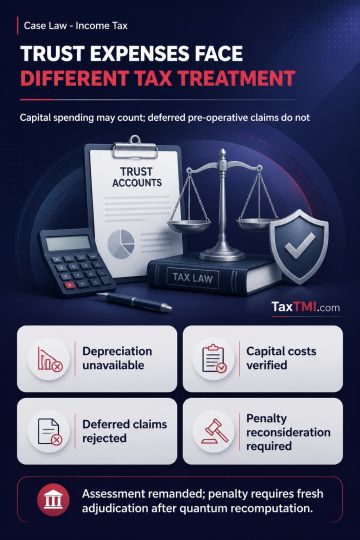
Charitable trust income application permits verified capital expenditure but rejects deferred pre-operative claims and requires reconsideration of con...
Reinsurance premium deductions require established regulatory breaches, while independently acquired software qualifies within the computer depreciati...
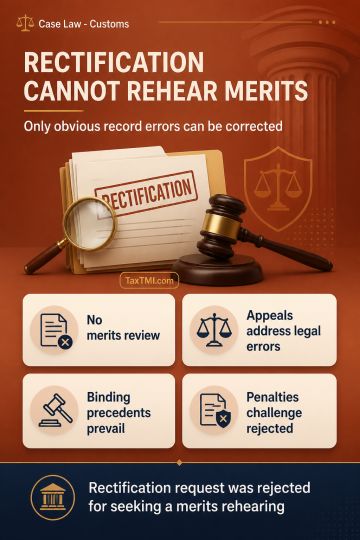
Rectification of mistake remains limited to self-evident record errors, preventing merits review through miscellaneous applications and preserving fin...
Tender creditworthiness conditions may extend to de facto Promoter Directors, with post-participation challenges generally barred absent arbitrariness...
Page of 4814
Press 'Enter' after typing page number.
1121 to 1140 of 96262 Results
❮
❯
❯❯
0 / 200
Expand Note
Add to Folder
No Folders have been created
+
Are you sure you want to delete "My most important" ?
A scrutiny notice issued without established prior administrative approval was held void ab initio, and the resulting assessment under section 143(3) was annulled for want of jurisdiction. Additions based on third-party seized material also failed because the Assessing Officer had not recorded the requisite satisfaction with competent approval, so the statutory jurisdictional preconditions were not met. The first appellate authority exceeded its power by converting an unexplained-money addition into a trading addition and by introducing a new basis of assessment. Alleged suppressed sales, unexplained money, unaccounted purchases, and estimated unexplained expenditure were deleted because the loose papers were uncorroborated, cross-examination weakened the nexus, and section 69C was applied on conjecture rather than proof.
A scrutiny notice issued without established prior administrative approval was held void ab initio, and the resulting assessment under section 143(3) was annulled for want of jurisdiction. Additions based on third-party seized material also failed because the Assessing Officer had not recorded the requisite satisfaction with competent approval, so the statutory jurisdictional preconditions were not met. The first appellate authority exceeded its power by converting an unexplained-money addition into a trading addition and by introducing a new basis of assessment. Alleged suppressed sales, unexplained money, unaccounted purchases, and estimated unexplained expenditure were deleted because the loose papers were uncorroborated, cross-examination weakened the nexus, and section 69C was applied on conjecture rather than proof.
Note: It is a system-generated summary and is for quick reference only.
 TaxTMI
  TaxTMI
 of 4814

















 Join Channel


