Development agreements require legal possession or effective enjoyment for capital gains transfer; permissive possession and deferred consideration de...
Prolonged sterilisation of development rights supports capital-gains treatment, while business-income disallowances cannot govern capital-gains comput...
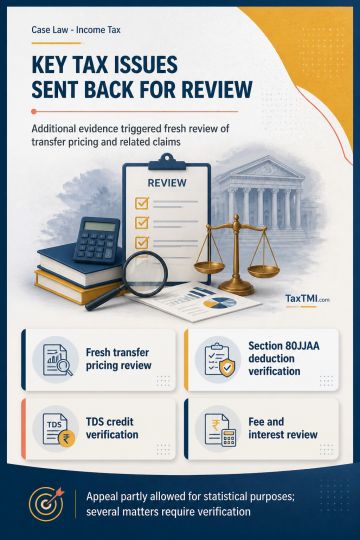
Additional evidence in transfer pricing dispute leads to fresh examination, while tax deductions, TDS credit, fee and refund interest require verifica...
Category II AIF pass-through taxation preserves non-business income character; investment receipts cannot be reclassified without applying recognised ...
Mutual fund maturity rules require proper rollover, redemption, disclosure, and due diligence; investor gains cannot excuse regulatory breaches or pen...
Page of 4809
Press 'Enter' after typing page number.
1381 to 1400 of 96177 Results
❮
❯
❯❯
0 / 200
Expand Note
Add to Folder
No Folders have been created
+
Are you sure you want to delete "My most important" ?
HC held that rectification withdrawing the claimed exemption and converting a refund into demand was procedurally invalid because no prior notice or hearing was given under the proviso to Section 154(3), and the refund was adjusted without prior intimation under Section 245, breaching natural justice. The Court therefore interfered on procedural grounds and left the merits of the exemption claim open. It also treated the matter as a high-pitched assessment case: since the assessee's appeal was pending with written submissions already on record, recovery was directed to remain stayed until final disposal of the appeal, and the appellate authority was directed to decide the appeal expeditiously by a reasoned order after hearing the assessee.
HC held that rectification withdrawing the claimed exemption and converting a refund into demand was procedurally invalid because no prior notice or hearing was given under the proviso to Section 154(3), and the refund was adjusted without prior intimation under Section 245, breaching natural justice. The Court therefore interfered on procedural grounds and left the merits of the exemption claim open. It also treated the matter as a high-pitched assessment case: since the assessee's appeal was pending with written submissions already on record, recovery was directed to remain stayed until final disposal of the appeal, and the appellate authority was directed to decide the appeal expeditiously by a reasoned order after hearing the assessee.
Note: It is a system-generated summary and is for quick reference only.
 TaxTMI
  TaxTMI
 of 4809
















 Join Channel