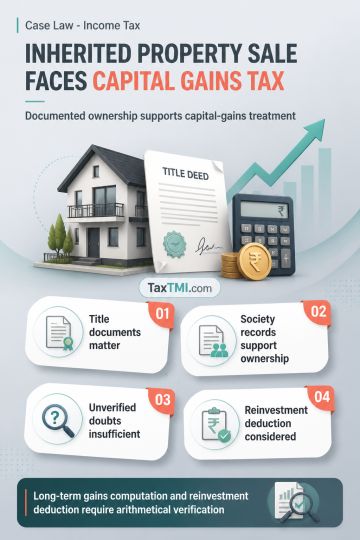
Inherited property sale proceeds require capital-gains treatment where ownership is supported by evidence, not suspicion or unverified signature doubt...
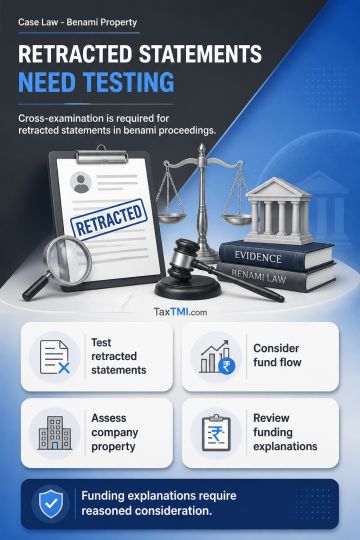
Cross-examination of retracted statements is essential where foundational evidence supports a benami allegation and documented funding explanations re...
Capital-goods exemption covers plant-modernisation accessories, while the import restriction applies only to earlier capital-goods components and spar...
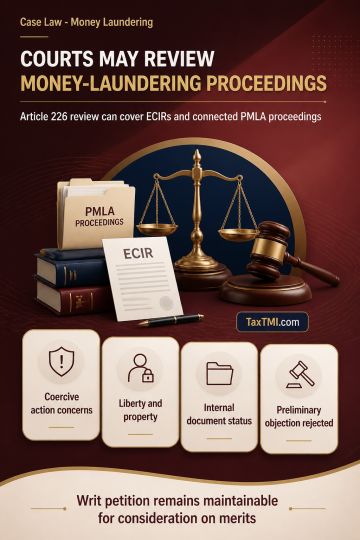
Constitutional judicial review permits challenges to ECIRs and connected money-laundering proceedings where coercive action affects fundamental intere...
Section 16(2)(c) of the CGST Act was upheld as a cumulative condition for input tax credit, and the purchaser must prove that tax charged on the supply was actually paid to the Government. The Court held that clauses (a) to (d) of Section 16(2) must be read conjointly, that ITC is a statutory concession rather than a vested right, and that non-payment by the supplier cannot be ignored merely because the recipient has the invoice and goods or services. Reading down was refused because the provision is clear, fits the GST scheme, and preserves revenue integrity against fraudulent transactions.
Section 16(2)(c) of the CGST Act was upheld as a cumulative condition for input tax credit, and the purchaser must prove that tax charged on the supply was actually paid to the Government. The Court held that clauses (a) to (d) of Section 16(2) must be read conjointly, that ITC is a statutory concession rather than a vested right, and that non-payment by the supplier cannot be ignored merely because the recipient has the invoice and goods or services. Reading down was refused because the provision is clear, fits the GST scheme, and preserves revenue integrity against fraudulent transactions.
Note: It is a system-generated summary and is for quick reference only.
 TaxTMI
  TaxTMI
 of 4817









 Join Channel