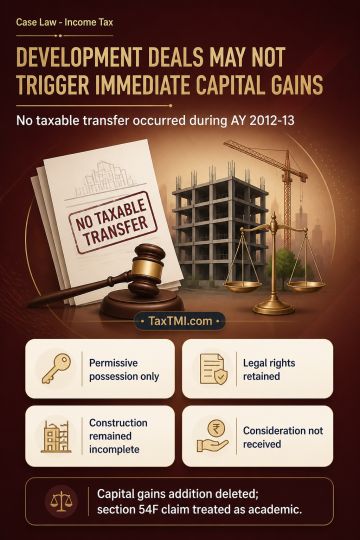
Development agreements require legal possession or effective enjoyment for capital gains transfer; permissive possession and deferred consideration de...
Prolonged sterilisation of development rights supports capital-gains treatment, while business-income disallowances cannot govern capital-gains comput...
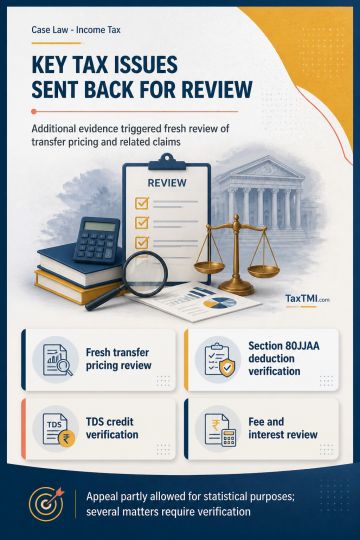
Additional evidence in transfer pricing dispute leads to fresh examination, while tax deductions, TDS credit, fee and refund interest require verifica...
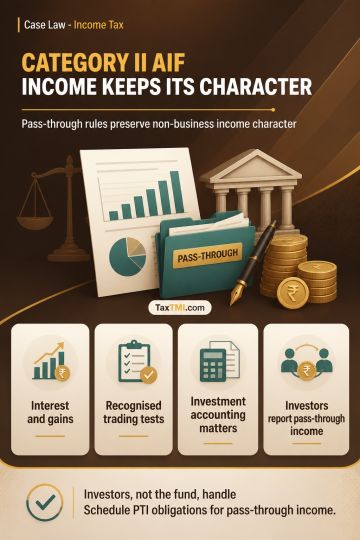
Category II AIF pass-through taxation preserves non-business income character; investment receipts cannot be reclassified without applying recognised ...
Page of 4814
Press 'Enter' after typing page number.
1461 to 1480 of 96262 Results
❮
❯
❯❯
0 / 200
Expand Note
Add to Folder
No Folders have been created
+
Are you sure you want to delete "My most important" ?
Payment of damages under an arbitral award did not amount to a taxable supply under the CGST Act because the settlement before the Delhi High Court was not an independent commercial arrangement to refrain from an act or tolerate a situation. The withdrawal or suspension of enforcement proceedings in the UK and US followed only from full satisfaction of the award and did not create separate consideration or a distinct service. In the absence of an independent contract and consideration, Section 7 and Entry 5(e) of Schedule II were inapplicable, and the IGST charge could not be sustained. The intimation and show cause notice were quashed for lack of jurisdiction, and the writ petition was entertained despite the alternate remedy rule.
Payment of damages under an arbitral award did not amount to a taxable supply under the CGST Act because the settlement before the Delhi High Court was not an independent commercial arrangement to refrain from an act or tolerate a situation. The withdrawal or suspension of enforcement proceedings in the UK and US followed only from full satisfaction of the award and did not create separate consideration or a distinct service. In the absence of an independent contract and consideration, Section 7 and Entry 5(e) of Schedule II were inapplicable, and the IGST charge could not be sustained. The intimation and show cause notice were quashed for lack of jurisdiction, and the writ petition was entertained despite the alternate remedy rule.
Note: It is a system-generated summary and is for quick reference only.
 TaxTMI
  TaxTMI
 of 4814







 Join Channel