Development agreements require legal possession or effective enjoyment for capital gains transfer; permissive possession and deferred consideration de...
Prolonged sterilisation of development rights supports capital-gains treatment, while business-income disallowances cannot govern capital-gains comput...
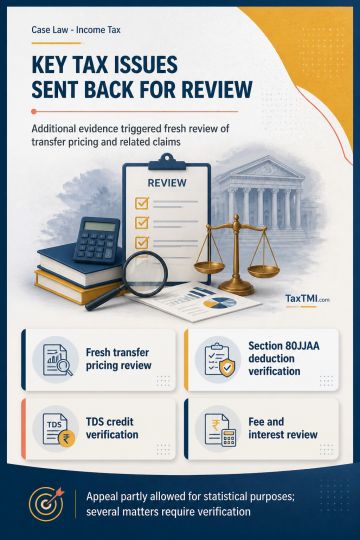
Additional evidence in transfer pricing dispute leads to fresh examination, while tax deductions, TDS credit, fee and refund interest require verifica...
Category II AIF pass-through taxation preserves non-business income character; investment receipts cannot be reclassified without applying recognised ...
Mutual fund maturity rules require proper rollover, redemption, disclosure, and due diligence; investor gains cannot excuse regulatory breaches or pen...
Page of 4813
Press 'Enter' after typing page number.
1461 to 1480 of 96257 Results
❮
❯
❯❯
0 / 200
Expand Note
Add to Folder
No Folders have been created
+
Are you sure you want to delete "My most important" ?
Section 32A was applied to protect the corporate debtor's property from attachment where an approved resolution plan had been implemented with a qualifying change in management. The Tribunal, following Manish Kumar, held that statutory immunity extends to property covered by the approved plan for offences committed before commencement of CIRP, so long as control passes to persons unconnected with the erstwhile management and not shown to have abetted or conspired in the offence. It rejected the argument that PMLA attachment could continue merely because the property was alleged to be proceeds of crime, and also noted that the underlying claim had already been finally rejected in insolvency proceedings. The attachment orders were set aside.
Section 32A was applied to protect the corporate debtor's property from attachment where an approved resolution plan had been implemented with a qualifying change in management. The Tribunal, following Manish Kumar, held that statutory immunity extends to property covered by the approved plan for offences committed before commencement of CIRP, so long as control passes to persons unconnected with the erstwhile management and not shown to have abetted or conspired in the offence. It rejected the argument that PMLA attachment could continue merely because the property was alleged to be proceeds of crime, and also noted that the underlying claim had already been finally rejected in insolvency proceedings. The attachment orders were set aside.
Note: It is a system-generated summary and is for quick reference only.
 TaxTMI
  TaxTMI
 of 4813



















 Join Channel