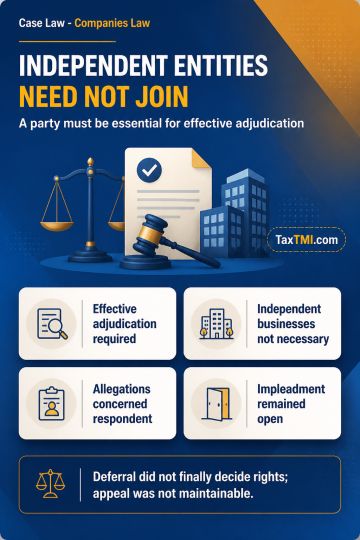
Necessary-party requirements limit impleadment of independent entities, while deferred consideration does not create an appealable adverse determinati...
Food supplement classification requires common parlance and authoritative tests, preventing treatment as proprietary Ayurvedic medicines without suppo...
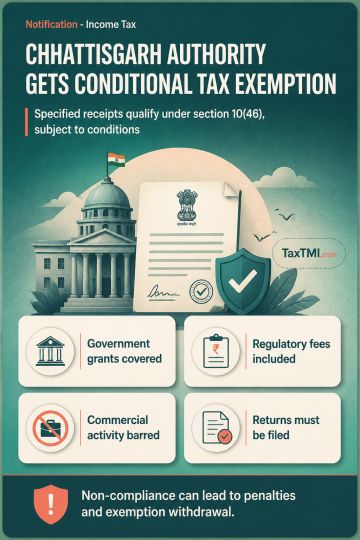
Specified regulatory authority income receives conditional tax exemption, subject to non-commercial activity, unchanged income character, and return f...
Tax exemption for regulatory authority income applies retrospectively, subject to non-commercial activity, unchanged income sources, and return-filing...
Input tax credit conditions remain constitutionally valid, with eligible recipient claims considered under GST circulars and retrospective filing dead...
Section 32A was applied to protect the corporate debtor's property from attachment where an approved resolution plan had been implemented with a qualifying change in management. The Tribunal, following Manish Kumar, held that statutory immunity extends to property covered by the approved plan for offences committed before commencement of CIRP, so long as control passes to persons unconnected with the erstwhile management and not shown to have abetted or conspired in the offence. It rejected the argument that PMLA attachment could continue merely because the property was alleged to be proceeds of crime, and also noted that the underlying claim had already been finally rejected in insolvency proceedings. The attachment orders were set aside.
Section 32A was applied to protect the corporate debtor's property from attachment where an approved resolution plan had been implemented with a qualifying change in management. The Tribunal, following Manish Kumar, held that statutory immunity extends to property covered by the approved plan for offences committed before commencement of CIRP, so long as control passes to persons unconnected with the erstwhile management and not shown to have abetted or conspired in the offence. It rejected the argument that PMLA attachment could continue merely because the property was alleged to be proceeds of crime, and also noted that the underlying claim had already been finally rejected in insolvency proceedings. The attachment orders were set aside.
Note: It is a system-generated summary and is for quick reference only.
 TaxTMI
  TaxTMI
 of 4817

















 Join Channel