Specialized Investment Fund distribution now requires dedicated certification, while transitional recognition preserves existing qualified distributor...
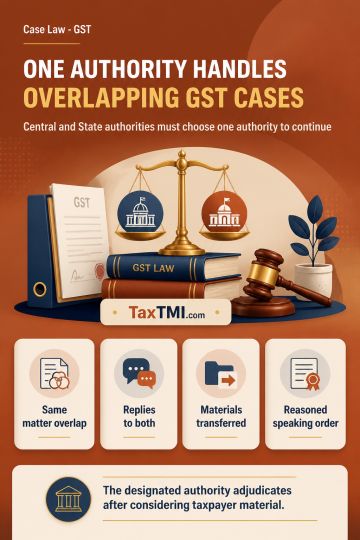
Overlapping GST proceedings require Central and State authorities to designate one competent authority for coordinated adjudication of the same matter...
Composite healthcare supplies retain exemption when patient care is the contract's essential character, despite payment through an implementing agency...
Page of 4816
Press 'Enter' after typing page number.
1221 to 1240 of 96301 Results
❮
❯
❯❯
0 / 200
Expand Note
Add to Folder
No Folders have been created
+
Are you sure you want to delete "My most important" ?
Mere deposit of cash in an electronic cash ledger does not amount to payment of GST unless the amount is appropriated to the Government exchequer under Section 49(1) read with Rule 87(6) and (7); where appropriation occurs later, the tax liability is discharged only then and interest remains payable for the period of delay. Input tax credit arising from reverse charge could not be availed before appropriation, but separate recovery of the wrongly availed credit was not justified after the taxpayer later made the debit entries and the amount stood appropriated. The Court also found that the question whether the omission reflected inadvertence or suppression with intent to evade tax required fresh factual consideration, and the composite order for two tax periods was set aside with remand for separate orders.
Mere deposit of cash in an electronic cash ledger does not amount to payment of GST unless the amount is appropriated to the Government exchequer under Section 49(1) read with Rule 87(6) and (7); where appropriation occurs later, the tax liability is discharged only then and interest remains payable for the period of delay. Input tax credit arising from reverse charge could not be availed before appropriation, but separate recovery of the wrongly availed credit was not justified after the taxpayer later made the debit entries and the amount stood appropriated. The Court also found that the question whether the omission reflected inadvertence or suppression with intent to evade tax required fresh factual consideration, and the composite order for two tax periods was set aside with remand for separate orders.
Note: It is a system-generated summary and is for quick reference only.
 TaxTMI
  TaxTMI
 of 4816















 Join Channel