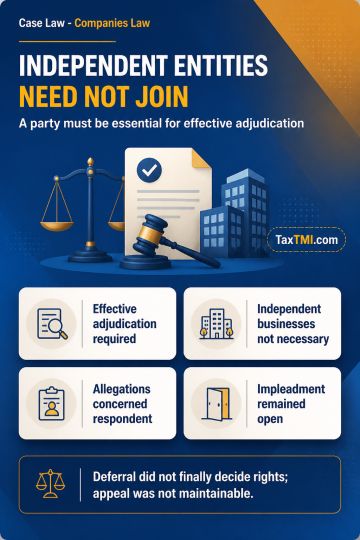
Necessary-party requirements limit impleadment of independent entities, while deferred consideration does not create an appealable adverse determinati...
Food supplement classification requires common parlance and authoritative tests, preventing treatment as proprietary Ayurvedic medicines without suppo...
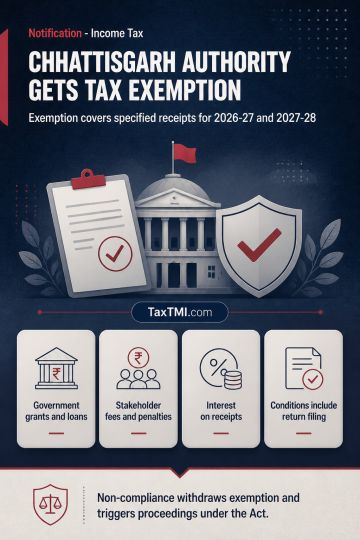
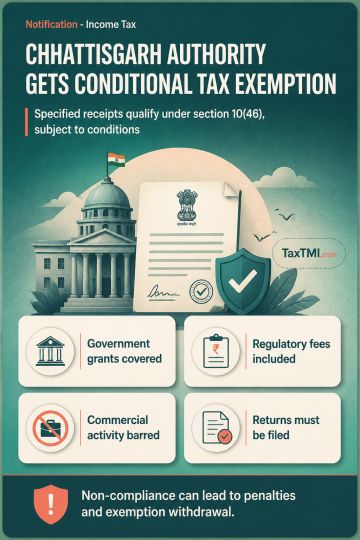
Specified regulatory authority income receives conditional tax exemption, subject to non-commercial activity, unchanged income character, and return f...
Tax exemption for regulatory authority income applies retrospectively, subject to non-commercial activity, unchanged income sources, and return-filing...
Input tax credit conditions remain constitutionally valid, with eligible recipient claims considered under GST circulars and retrospective filing dead...
Mere deposit of cash in an electronic cash ledger does not amount to payment of GST unless the amount is appropriated to the Government exchequer under Section 49(1) read with Rule 87(6) and (7); where appropriation occurs later, the tax liability is discharged only then and interest remains payable for the period of delay. Input tax credit arising from reverse charge could not be availed before appropriation, but separate recovery of the wrongly availed credit was not justified after the taxpayer later made the debit entries and the amount stood appropriated. The Court also found that the question whether the omission reflected inadvertence or suppression with intent to evade tax required fresh factual consideration, and the composite order for two tax periods was set aside with remand for separate orders.
Mere deposit of cash in an electronic cash ledger does not amount to payment of GST unless the amount is appropriated to the Government exchequer under Section 49(1) read with Rule 87(6) and (7); where appropriation occurs later, the tax liability is discharged only then and interest remains payable for the period of delay. Input tax credit arising from reverse charge could not be availed before appropriation, but separate recovery of the wrongly availed credit was not justified after the taxpayer later made the debit entries and the amount stood appropriated. The Court also found that the question whether the omission reflected inadvertence or suppression with intent to evade tax required fresh factual consideration, and the composite order for two tax periods was set aside with remand for separate orders.
Note: It is a system-generated summary and is for quick reference only.
 TaxTMI
  TaxTMI
 of 4816















 Join Channel