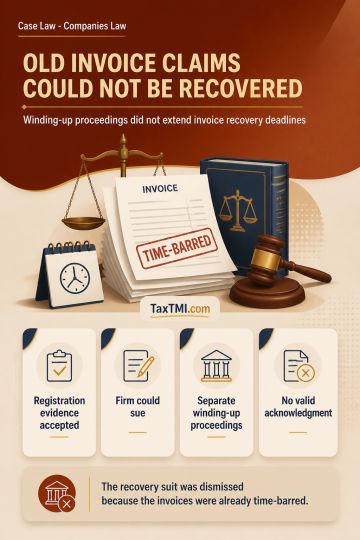
Invoice-based recovery claims remain time-barred despite separate winding-up proceedings, absent valid acknowledgment or part-payment of the disputed ...
Extended limitation fails without specific suppression allegations, while overseas employee secondment remains taxable as manpower supply within norma...
Time-share accommodation classification excludes Club or Association Service where purchasers receive contractual occupancy rights without genuine mem...
CENVAT credit for trading requires reversal, while taxable-service rental credit remains proportionately available and limitation issues await resolut...
Page of 4817
Press 'Enter' after typing page number.
561 to 580 of 96333 Results
❮
❯
❯❯
0 / 200
Expand Note
Add to Folder
No Folders have been created
+
Are you sure you want to delete "My most important" ?
Section 2(28C) defining "Joint Commissioner" to include the Additional Commissioner governed the approval requirement for penalty proceedings, and a harmonious reading of the Act showed no indication in section 274(2) that the inclusive definition was excluded. Provisions that separately mentioned both officers were treated as clarificatory rather than restrictive, and reading the term otherwise would make the statutory definition ineffective. Prior approval by the Additional Commissioner was therefore valid compliance with the approval requirement, and the challenge to the penalty proceedings on want of proper sanction failed. The writ petitions were dismissed, with liberty preserved to pursue statutory remedies on the merits.
Section 2(28C) defining "Joint Commissioner" to include the Additional Commissioner governed the approval requirement for penalty proceedings, and a harmonious reading of the Act showed no indication in section 274(2) that the inclusive definition was excluded. Provisions that separately mentioned both officers were treated as clarificatory rather than restrictive, and reading the term otherwise would make the statutory definition ineffective. Prior approval by the Additional Commissioner was therefore valid compliance with the approval requirement, and the challenge to the penalty proceedings on want of proper sanction failed. The writ petitions were dismissed, with liberty preserved to pursue statutory remedies on the merits.
Note: It is a system-generated summary and is for quick reference only.
 TaxTMI
  TaxTMI
 of 4817

















 Join Channel


