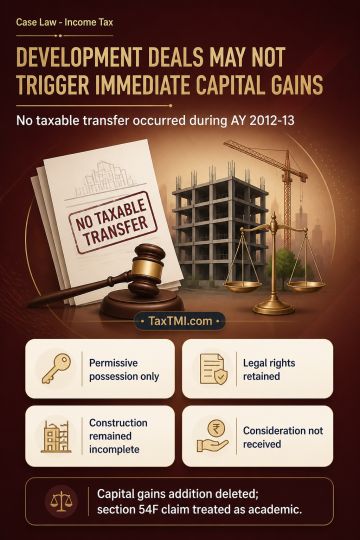
Development agreements require legal possession or effective enjoyment for capital gains transfer; permissive possession and deferred consideration de...
Prolonged sterilisation of development rights supports capital-gains treatment, while business-income disallowances cannot govern capital-gains comput...
Additional evidence in transfer pricing dispute leads to fresh examination, while tax deductions, TDS credit, fee and refund interest require verifica...
Category II AIF pass-through taxation preserves non-business income character; investment receipts cannot be reclassified without applying recognised ...
Bluetooth wireless earphones, headphones, earbuds and neckbands were classified as headphones or earphones under CTI 8518 30 00 because their objective character and commercial identity fell within the specific eo nomine heading for audio reproduction devices. Bluetooth connectivity was treated as only the means of linking to a device, not as altering the essential nature of the goods into data transmission equipment, so the broader residual heading in 8517 was rejected. The concessional notification linked to CTI 8517 62 90 was therefore unavailable, and the duty demand was sustainable on merits. However, the extended period of limitation was not justified because the dispute was one of classification and intent to evade duty was not established; penalty under section 114A also could not survive. The matter was remitted only for the normal-period demand and consequential interest.
Bluetooth wireless earphones, headphones, earbuds and neckbands were classified as headphones or earphones under CTI 8518 30 00 because their objective character and commercial identity fell within the specific eo nomine heading for audio reproduction devices. Bluetooth connectivity was treated as only the means of linking to a device, not as altering the essential nature of the goods into data transmission equipment, so the broader residual heading in 8517 was rejected. The concessional notification linked to CTI 8517 62 90 was therefore unavailable, and the duty demand was sustainable on merits. However, the extended period of limitation was not justified because the dispute was one of classification and intent to evade duty was not established; penalty under section 114A also could not survive. The matter was remitted only for the normal-period demand and consequential interest.
Note: It is a system-generated summary and is for quick reference only.
 TaxTMI
  TaxTMI
 of 4816













 Join Channel




