Development agreements require legal possession or effective enjoyment for capital gains transfer; permissive possession and deferred consideration de...
Prolonged sterilisation of development rights supports capital-gains treatment, while business-income disallowances cannot govern capital-gains comput...
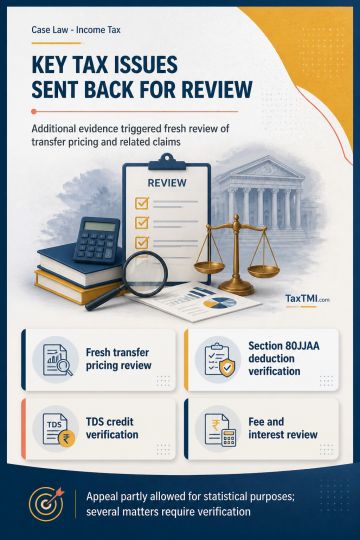
Additional evidence in transfer pricing dispute leads to fresh examination, while tax deductions, TDS credit, fee and refund interest require verifica...
Category II AIF pass-through taxation preserves non-business income character; investment receipts cannot be reclassified without applying recognised ...
Mutual fund maturity rules require proper rollover, redemption, disclosure, and due diligence; investor gains cannot excuse regulatory breaches or pen...
Page of 4813
Press 'Enter' after typing page number.
1461 to 1480 of 96257 Results
❮
❯
❯❯
0 / 200
Expand Note
Add to Folder
No Folders have been created
+
Are you sure you want to delete "My most important" ?
Preferential duty exemption under SAFTA was upheld where the certificates of origin, later verified by Bangladesh authorities, were confirmed as correct and could not be disregarded on a unilateral assumption about the origin of the goods. The Tribunal also rejected selective retesting and extrapolation of a few later laboratory results to all consignments, finding the method legally untenable and inconsistent with the original reports. It further held that the extended period of limitation was unavailable because the import documents had been disclosed at clearance and no suppression, wilful misstatement or collusion was proved. The objection that recovery proceedings were invalid for want of a departmental appeal against self-assessed bills of entry was also rejected.
Preferential duty exemption under SAFTA was upheld where the certificates of origin, later verified by Bangladesh authorities, were confirmed as correct and could not be disregarded on a unilateral assumption about the origin of the goods. The Tribunal also rejected selective retesting and extrapolation of a few later laboratory results to all consignments, finding the method legally untenable and inconsistent with the original reports. It further held that the extended period of limitation was unavailable because the import documents had been disclosed at clearance and no suppression, wilful misstatement or collusion was proved. The objection that recovery proceedings were invalid for want of a departmental appeal against self-assessed bills of entry was also rejected.
Note: It is a system-generated summary and is for quick reference only.
 TaxTMI
  TaxTMI
 of 4813












 Join Channel