Development agreements require legal possession or effective enjoyment for capital gains transfer; permissive possession and deferred consideration de...
Prolonged sterilisation of development rights supports capital-gains treatment, while business-income disallowances cannot govern capital-gains comput...
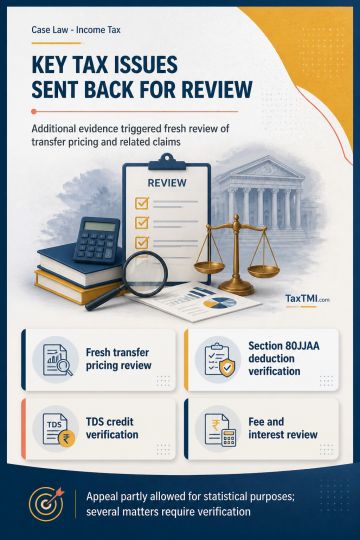
Additional evidence in transfer pricing dispute leads to fresh examination, while tax deductions, TDS credit, fee and refund interest require verifica...
Category II AIF pass-through taxation preserves non-business income character; investment receipts cannot be reclassified without applying recognised ...
Page of 4814
Press 'Enter' after typing page number.
1461 to 1480 of 96262 Results
❮
❯
❯❯
0 / 200
Expand Note
Add to Folder
No Folders have been created
+
Are you sure you want to delete "My most important" ?
Entities registered as societies were treated as governmental authorities because they were established and wholly controlled by the Haryana Government to perform citizen-facing statutory functions through e-governance, and the amounts collected were statutory fees rather than commercial consideration. On that basis, services relating to municipal functions under Notification No. 25/2012-ST were exempt, so the service tax demand on merits failed. The Tribunal also found no suppression or intent to evade tax: the dispute was interpretational, the activities were in the public domain, and the entities acted under bona fide belief. The extended period and consequential penalties under Sections 77 and 78 were therefore unsustainable.
Entities registered as societies were treated as governmental authorities because they were established and wholly controlled by the Haryana Government to perform citizen-facing statutory functions through e-governance, and the amounts collected were statutory fees rather than commercial consideration. On that basis, services relating to municipal functions under Notification No. 25/2012-ST were exempt, so the service tax demand on merits failed. The Tribunal also found no suppression or intent to evade tax: the dispute was interpretational, the activities were in the public domain, and the entities acted under bona fide belief. The extended period and consequential penalties under Sections 77 and 78 were therefore unsustainable.
Note: It is a system-generated summary and is for quick reference only.
 TaxTMI
  TaxTMI
 of 4814













 Join Channel