Development agreements require legal possession or effective enjoyment for capital gains transfer; permissive possession and deferred consideration de...
Prolonged sterilisation of development rights supports capital-gains treatment, while business-income disallowances cannot govern capital-gains comput...
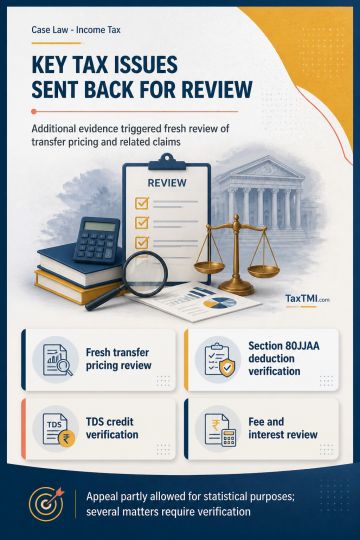
Additional evidence in transfer pricing dispute leads to fresh examination, while tax deductions, TDS credit, fee and refund interest require verifica...
Category II AIF pass-through taxation preserves non-business income character; investment receipts cannot be reclassified without applying recognised ...
Corporate guarantees executed by the corporate debtor were held to constitute financial debt under Section 5(8) of the Code because liabilities under guarantees for money borrowed against payment of interest fall within that definition. The Court accepted that the guarantees were in existence and had been verified, and held that non-disclosure in financial statements did not defeat the substantive claim. It further held that non-submission before the NCLT was not fatal, since documents could be produced on appeal and the resolution professional was entitled to verify claims. Insufficient stamping was treated as a curable defect, not a ground to render the guarantees unenforceable. The concurrent findings rejecting the claims were found perverse and were set aside, with directions to include the appellants in the committee of creditors.
Corporate guarantees executed by the corporate debtor were held to constitute financial debt under Section 5(8) of the Code because liabilities under guarantees for money borrowed against payment of interest fall within that definition. The Court accepted that the guarantees were in existence and had been verified, and held that non-disclosure in financial statements did not defeat the substantive claim. It further held that non-submission before the NCLT was not fatal, since documents could be produced on appeal and the resolution professional was entitled to verify claims. Insufficient stamping was treated as a curable defect, not a ground to render the guarantees unenforceable. The concurrent findings rejecting the claims were found perverse and were set aside, with directions to include the appellants in the committee of creditors.
Note: It is a system-generated summary and is for quick reference only.
 TaxTMI
  TaxTMI
 of 4816













 Join Channel