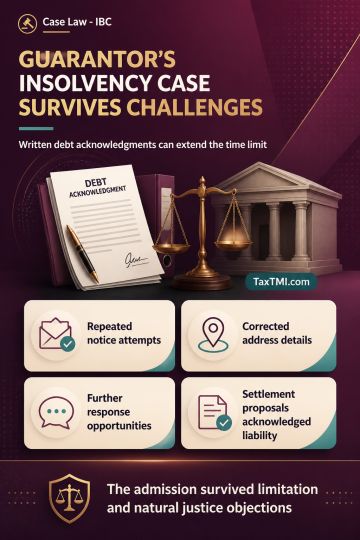
Service of notice and contractual debt acknowledgment preserved insolvency admission against a corporate guarantor despite limitation and natural just...
Original works exemption excludes standalone boulder transportation, leaving subcontracted railway-project transport services subject to service tax l...
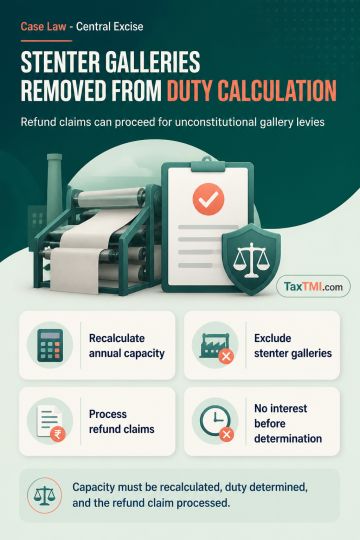
Annual production capacity determinations excluding stenter galleries support refunds for unconstitutional excise levies without an unjust-enrichment ...
Vicarious liability for cheque dishonour requires specific allegations of responsibility and cheque signatory; generic director allegations cannot sus...
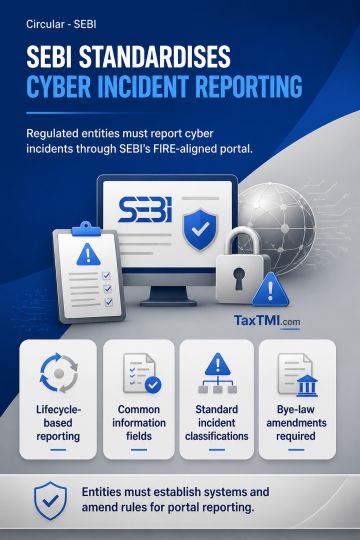
IT Resilience Index requires market infrastructure institutions to automate resilience scoring, early warnings, and continuous service-delivery monito...
Corporate guarantees executed by the corporate debtor were held to constitute financial debt under Section 5(8) of the Code because liabilities under guarantees for money borrowed against payment of interest fall within that definition. The Court accepted that the guarantees were in existence and had been verified, and held that non-disclosure in financial statements did not defeat the substantive claim. It further held that non-submission before the NCLT was not fatal, since documents could be produced on appeal and the resolution professional was entitled to verify claims. Insufficient stamping was treated as a curable defect, not a ground to render the guarantees unenforceable. The concurrent findings rejecting the claims were found perverse and were set aside, with directions to include the appellants in the committee of creditors.
Corporate guarantees executed by the corporate debtor were held to constitute financial debt under Section 5(8) of the Code because liabilities under guarantees for money borrowed against payment of interest fall within that definition. The Court accepted that the guarantees were in existence and had been verified, and held that non-disclosure in financial statements did not defeat the substantive claim. It further held that non-submission before the NCLT was not fatal, since documents could be produced on appeal and the resolution professional was entitled to verify claims. Insufficient stamping was treated as a curable defect, not a ground to render the guarantees unenforceable. The concurrent findings rejecting the claims were found perverse and were set aside, with directions to include the appellants in the committee of creditors.
Note: It is a system-generated summary and is for quick reference only.
 TaxTMI
  TaxTMI
 of 4826










 Join Channel