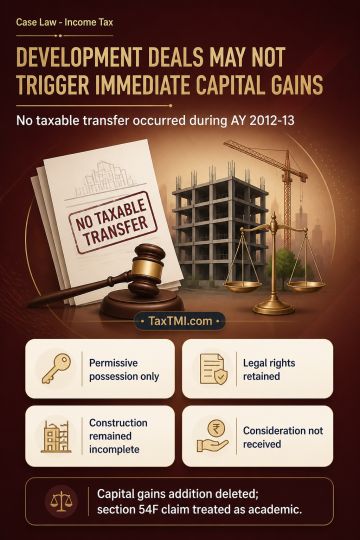
Development agreements require legal possession or effective enjoyment for capital gains transfer; permissive possession and deferred consideration de...
Prolonged sterilisation of development rights supports capital-gains treatment, while business-income disallowances cannot govern capital-gains comput...
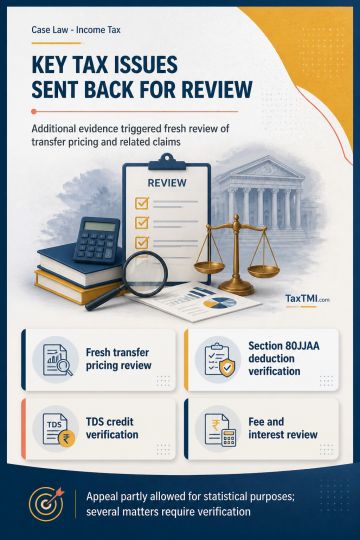
Additional evidence in transfer pricing dispute leads to fresh examination, while tax deductions, TDS credit, fee and refund interest require verifica...
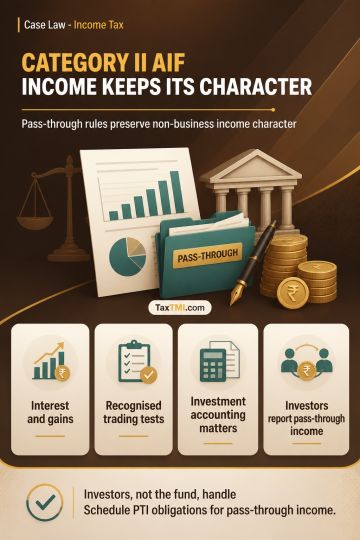
Category II AIF pass-through taxation preserves non-business income character; investment receipts cannot be reclassified without applying recognised ...
Illness supported by undisputed medical material was treated as sufficient cause for condoning a 36-day delay in a petition under Section 58(3) of the Companies Act, with the Tribunal noting that the explanation remained uncontroverted despite opportunity. It held that "sufficient cause" is to be construed liberally to secure decision on merits, that Section 58(3) does not create a non-condonable outer limit, and that the Limitation Act principles could apply through Section 433 read with Section 29, with Rule 11 also available to advance substantial justice. The challenge to condonation was rejected and the delay remained condoned.
Illness supported by undisputed medical material was treated as sufficient cause for condoning a 36-day delay in a petition under Section 58(3) of the Companies Act, with the Tribunal noting that the explanation remained uncontroverted despite opportunity. It held that "sufficient cause" is to be construed liberally to secure decision on merits, that Section 58(3) does not create a non-condonable outer limit, and that the Limitation Act principles could apply through Section 433 read with Section 29, with Rule 11 also available to advance substantial justice. The challenge to condonation was rejected and the delay remained condoned.
Note: It is a system-generated summary and is for quick reference only.
 TaxTMI
  TaxTMI
 of 4807




 Join Channel


