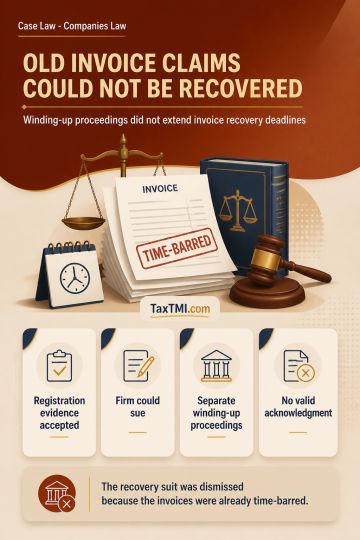
Invoice-based recovery claims remain time-barred despite separate winding-up proceedings, absent valid acknowledgment or part-payment of the disputed ...
Extended limitation fails without specific suppression allegations, while overseas employee secondment remains taxable as manpower supply within norma...
Time-share accommodation classification excludes Club or Association Service where purchasers receive contractual occupancy rights without genuine mem...
Page of 4809
Press 'Enter' after typing page number.
401 to 420 of 96174 Results
❮
❯
❯❯
0 / 200
Expand Note
Add to Folder
No Folders have been created
+
Are you sure you want to delete "My most important" ?
The HC held that Section 153A uses two different computation methods for search assessments. For the six-year block, the phrase "immediately preceding" excludes the search assessment year; for the extended ten-year block in Explanation 1, the period is computed "from the end of" the assessment year relevant to the year of search, so the search assessment year is included as the first year. The Court rejected the Revenue's attempt to apply the six-year exclusion rule to the ten-year period. On that interpretation, Assessment Year 2015-16 was beyond the permissible ten-year span and the notice under Section 148 was quashed as time-barred.
The HC held that Section 153A uses two different computation methods for search assessments. For the six-year block, the phrase "immediately preceding" excludes the search assessment year; for the extended ten-year block in Explanation 1, the period is computed "from the end of" the assessment year relevant to the year of search, so the search assessment year is included as the first year. The Court rejected the Revenue's attempt to apply the six-year exclusion rule to the ten-year period. On that interpretation, Assessment Year 2015-16 was beyond the permissible ten-year span and the notice under Section 148 was quashed as time-barred.
Note: It is a system-generated summary and is for quick reference only.
 TaxTMI
  TaxTMI
 of 4809












 Join Channel


