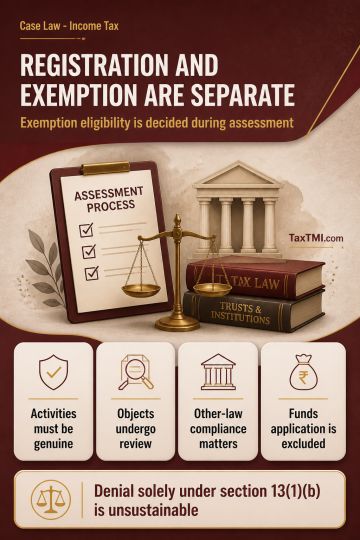
Defined public benefit can retain charitable character; registration renewal requires examining genuine activities and legal compliance, not surplus a...
Capital reduction is distinct from share buy-back, preventing buy-back tax; restructuring interest and related business deductions also survive scruti...
Transfer pricing and tax deductions upheld on established principles, while employee contributions and warranty provisions returned for fresh examinat...
Captive transfer pricing relies on industrial consumer tariffs, while genuine quotations can benchmark effluent treatment transfers under the Other Me...
Specific tariff classification for ophthalmic instruments and extended limitation principles determine the treatment of duty demands, confiscation, an...
Page of 4816
Press 'Enter' after typing page number.
1461 to 1480 of 96301 Results
❮
❯
❯❯
0 / 200
Expand Note
Add to Folder
No Folders have been created
+
Are you sure you want to delete "My most important" ?
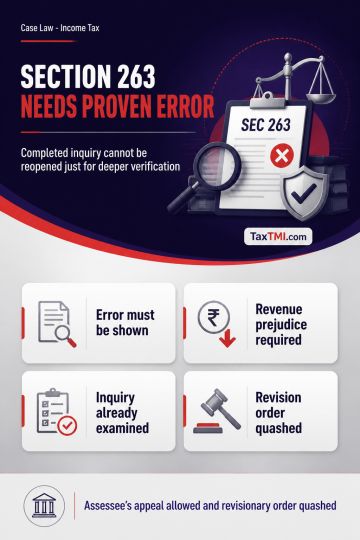
A revision under section 263 was sustained where the Assessing Officer had not made the enquiry and verification the scrutiny assessment required. The Tribunal noted that only generalized notices had been issued, with no real examination, follow-up enquiry or application of mind on the selected scrutiny issues, including expense claims, related-party payments and tax deduction defaults. It applied the principle that merely calling for details and filing them on record is not enough to constitute enquiry, and that Explanation 2(a) to section 263 applies when no proper view is formed after due examination. The assessee's contention that disclosure of details barred revision was rejected.
A revision under section 263 was sustained where the Assessing Officer had not made the enquiry and verification the scrutiny assessment required. The Tribunal noted that only generalized notices had been issued, with no real examination, follow-up enquiry or application of mind on the selected scrutiny issues, including expense claims, related-party payments and tax deduction defaults. It applied the principle that merely calling for details and filing them on record is not enough to constitute enquiry, and that Explanation 2(a) to section 263 applies when no proper view is formed after due examination. The assessee's contention that disclosure of details barred revision was rejected.
Note: It is a system-generated summary and is for quick reference only.
 TaxTMI
  TaxTMI
 of 4816

















 Join Channel




