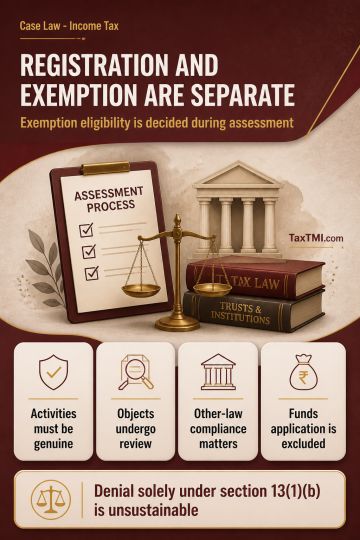
Defined public benefit can retain charitable character; registration renewal requires examining genuine activities and legal compliance, not surplus a...
Capital reduction is distinct from share buy-back, preventing buy-back tax; restructuring interest and related business deductions also survive scruti...
Transfer pricing and tax deductions upheld on established principles, while employee contributions and warranty provisions returned for fresh examinat...
Captive transfer pricing relies on industrial consumer tariffs, while genuine quotations can benchmark effluent treatment transfers under the Other Me...
Specific tariff classification for ophthalmic instruments and extended limitation principles determine the treatment of duty demands, confiscation, an...
Page of 4816
Press 'Enter' after typing page number.
1461 to 1480 of 96301 Results
❮
❯
❯❯
0 / 200
Expand Note
Add to Folder
No Folders have been created
+
Are you sure you want to delete "My most important" ?
A resolution plan was rejected because material non-compliances in the CIRP, including inadequate disclosure of avoidance/PUFE transactions, non-transparent handling of those proceedings, and lapses in performance security, undermined the fairness of the process. The Appellate Tribunal held that the Committee of Creditors' commercial wisdom could not cure defects where other applicants were deprived of material information and the plan proceeded on incomplete disclosure. It also upheld adverse findings against the erstwhile resolution professional, noting unsatisfactory explanations for failures in dealing with avoidance applications and security compliance. Both appeals were dismissed, and the direction to investigate the resolution professional's conduct was maintained.
A resolution plan was rejected because material non-compliances in the CIRP, including inadequate disclosure of avoidance/PUFE transactions, non-transparent handling of those proceedings, and lapses in performance security, undermined the fairness of the process. The Appellate Tribunal held that the Committee of Creditors' commercial wisdom could not cure defects where other applicants were deprived of material information and the plan proceeded on incomplete disclosure. It also upheld adverse findings against the erstwhile resolution professional, noting unsatisfactory explanations for failures in dealing with avoidance applications and security compliance. Both appeals were dismissed, and the direction to investigate the resolution professional's conduct was maintained.
Note: It is a system-generated summary and is for quick reference only.
 TaxTMI
  TaxTMI
 of 4816


















 Join Channel




