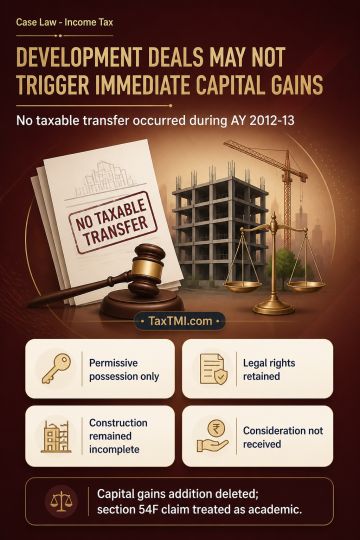
Development agreements require legal possession or effective enjoyment for capital gains transfer; permissive possession and deferred consideration de...
Prolonged sterilisation of development rights supports capital-gains treatment, while business-income disallowances cannot govern capital-gains comput...
Additional evidence in transfer pricing dispute leads to fresh examination, while tax deductions, TDS credit, fee and refund interest require verifica...
Category II AIF pass-through taxation preserves non-business income character; investment receipts cannot be reclassified without applying recognised ...
Biodegradable bag classification depends on constituent material: bags made of polymer or compostable plastics fall under Chapter 39, while bags made of paper fall under Chapter 48. The Authority declined to determine actual biodegradability or compostability, treating that as a scientific question outside its jurisdiction under Section 97(2). Entry No. 319 of Schedule I grants a 5% concessional rate for paper sacks/bags and biodegradable bags only if the goods are in fact biodegradable; if that condition is not met, the concessional entry does not apply and the general rate under the applicable Chapter 39 classification governs.
Biodegradable bag classification depends on constituent material: bags made of polymer or compostable plastics fall under Chapter 39, while bags made of paper fall under Chapter 48. The Authority declined to determine actual biodegradability or compostability, treating that as a scientific question outside its jurisdiction under Section 97(2). Entry No. 319 of Schedule I grants a 5% concessional rate for paper sacks/bags and biodegradable bags only if the goods are in fact biodegradable; if that condition is not met, the concessional entry does not apply and the general rate under the applicable Chapter 39 classification governs.
Note: It is a system-generated summary and is for quick reference only.
 TaxTMI
  TaxTMI
 of 4816













 Join Channel




