Charitable registration renewal cannot become an assessment of receipts, profitability or annual exemption compliance, requiring renewal and donation ...
AMP expenditure for own business is not an international transaction without an associated-enterprise arrangement, eliminating transfer pricing adjust...
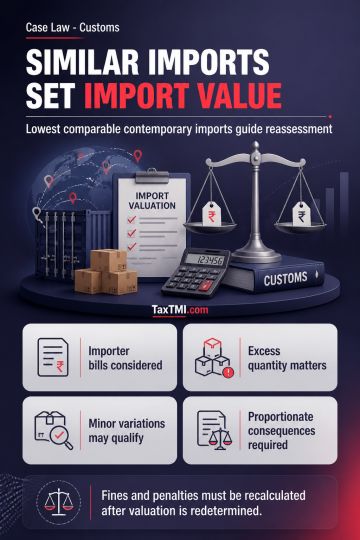
Customs valuation must use comparable contemporary imports, while confiscation fines and penalties require proportionate recalculation on reassessed v...
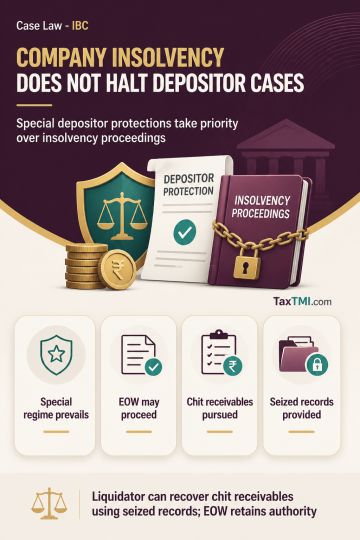
Depositor-protection proceedings prevail over corporate insolvency, while liquidators may recover chit receivables using copies of seized company reco...
Intermediary service classification fails where overseas admission facilitation is supplied independently, preserving export treatment and small-provi...
Satellite transponder bandwidth is telecommunication, not Business Support Service; foreign non-telegraph providers triggered no service tax liability...
Page of 4819
Press 'Enter' after typing page number.
341 to 360 of 96363 Results
❮
❯
❯❯
0 / 200
Expand Note
Add to Folder
No Folders have been created
+
Are you sure you want to delete "My most important" ?
Business and management consultancy charges closely linked to the assessee's operations were held to be benchmarked on an aggregated basis under TNMM, not by a separate ALP analysis, where receipt of services was supported by additional evidence; the matter was remitted for fresh examination by the TPO after considering that evidence. For outstanding receivables from the associated enterprise, the Tribunal applied average LIBOR as the appropriate benchmark rate for delayed payment interest, rejecting the ad hoc higher rate adopted by the lower authorities. The appeal was partly allowed, with consultancy charges sent back for recomputation and receivable interest directed to be recalculated using average LIBOR.
Business and management consultancy charges closely linked to the assessee's operations were held to be benchmarked on an aggregated basis under TNMM, not by a separate ALP analysis, where receipt of services was supported by additional evidence; the matter was remitted for fresh examination by the TPO after considering that evidence. For outstanding receivables from the associated enterprise, the Tribunal applied average LIBOR as the appropriate benchmark rate for delayed payment interest, rejecting the ad hoc higher rate adopted by the lower authorities. The appeal was partly allowed, with consultancy charges sent back for recomputation and receivable interest directed to be recalculated using average LIBOR.
Note: It is a system-generated summary and is for quick reference only.
 TaxTMI
  TaxTMI
 of 4819




















 Join Channel


