Transfer pricing and tax deductions upheld on established principles, while employee contributions and warranty provisions returned for fresh examinat...
Captive transfer pricing relies on industrial consumer tariffs, while genuine quotations can benchmark effluent treatment transfers under the Other Me...
Specific tariff classification for ophthalmic instruments and extended limitation principles determine the treatment of duty demands, confiscation, an...
Integrated golf function determines classification, placing launch monitors and simulators under other golf equipment rather than measuring instrument...
Public servant status under anti-corruption law extends to recognised stock exchange leadership; constitutional and sanction challenges do not succeed...
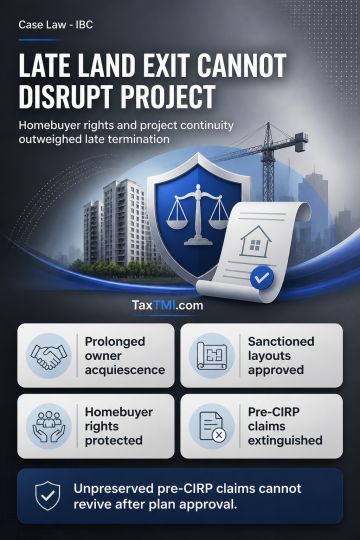
Acquiescence, homebuyer protection and clean-slate resolution principles prevent landowners from disrupting an integrated project through late termina...
Page of 4817
Press 'Enter' after typing page number.
1501 to 1520 of 96333 Results
❮
❯
❯❯
0 / 200
Expand Note
Add to Folder
No Folders have been created
+
Are you sure you want to delete "My most important" ?
Section 7 proceedings based on a money decree cannot be used as a substitute for execution where the real dispute concerns computation of the decretal balance and ordinary enforcement remedies remain available. The Court reiterated that the IBC is meant for genuine insolvency and revival, not coercive debt recovery; on these facts, the corporate debtor was solvent, substantial payments had already been made, and the computation issue was already pending before the Delhi High Court. Although a money decree may in principle give rise to a fresh cause of action for insolvency proceedings, that principle is not automatic and the adjudicating forum must still guard against abuse. The NCLAT erred in treating the decree alone as sufficient; the insolvency application was restored to dismissal and execution was left open as the proper remedy.
Section 7 proceedings based on a money decree cannot be used as a substitute for execution where the real dispute concerns computation of the decretal balance and ordinary enforcement remedies remain available. The Court reiterated that the IBC is meant for genuine insolvency and revival, not coercive debt recovery; on these facts, the corporate debtor was solvent, substantial payments had already been made, and the computation issue was already pending before the Delhi High Court. Although a money decree may in principle give rise to a fresh cause of action for insolvency proceedings, that principle is not automatic and the adjudicating forum must still guard against abuse. The NCLAT erred in treating the decree alone as sufficient; the insolvency application was restored to dismissal and execution was left open as the proper remedy.
Note: It is a system-generated summary and is for quick reference only.
 TaxTMI
  TaxTMI
 of 4817





















 Join Channel