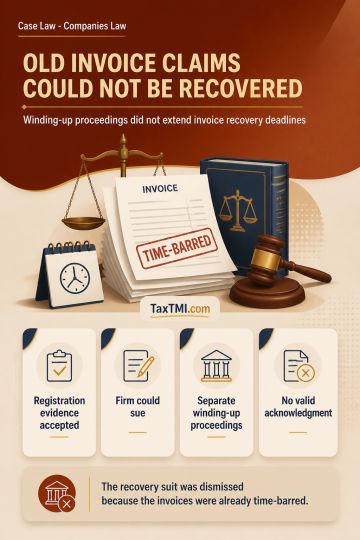
Invoice-based recovery claims remain time-barred despite separate winding-up proceedings, absent valid acknowledgment or part-payment of the disputed ...
Extended limitation fails without specific suppression allegations, while overseas employee secondment remains taxable as manpower supply within norma...
Time-share accommodation classification excludes Club or Association Service where purchasers receive contractual occupancy rights without genuine mem...
CENVAT credit for trading requires reversal, while taxable-service rental credit remains proportionately available and limitation issues await resolut...
Vicarious liability for dishonoured company cheques may extend to non-signatory directors where complaints contain foundational responsibility avermen...
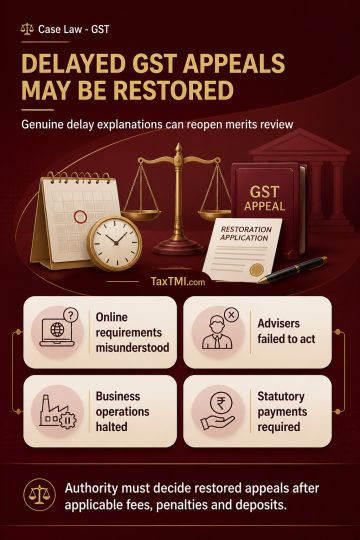
Writ jurisdiction can be used to restore a GST appellate remedy where the statutory condonation limit prevents consideration of a delayed appeal, if the delay is shown to arise from circumstances beyond the appellant's control. The Court treated cancellation of GST registration as affecting the ability to carry on business and livelihood, and found that refusal to hear the appeal on merits would cause grave prejudice. It therefore condoned the 720-day delay, set aside the order rejecting the appeal as time-barred, and directed the appellate authority to hear and decide the appeal on merits.
Writ jurisdiction can be used to restore a GST appellate remedy where the statutory condonation limit prevents consideration of a delayed appeal, if the delay is shown to arise from circumstances beyond the appellant's control. The Court treated cancellation of GST registration as affecting the ability to carry on business and livelihood, and found that refusal to hear the appeal on merits would cause grave prejudice. It therefore condoned the 720-day delay, set aside the order rejecting the appeal as time-barred, and directed the appellate authority to hear and decide the appeal on merits.
Note: It is a system-generated summary and is for quick reference only.
 TaxTMI
  TaxTMI
 of 4821















 Join Channel