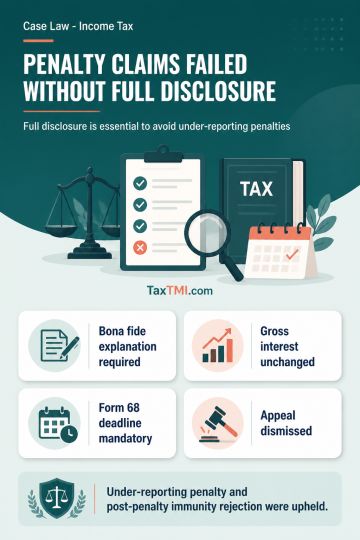
Bona fide disclosure requirements govern under-reporting penalties, and post-penalty immunity applications cannot secure available statutory protectio...
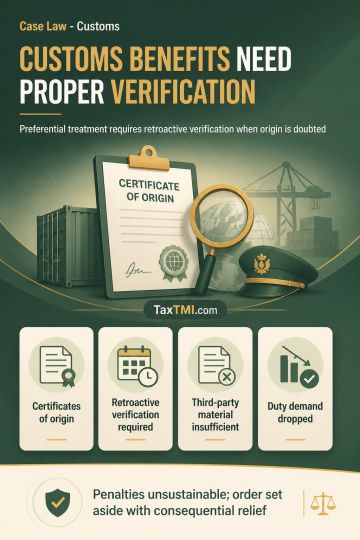
Certificate-of-origin verification procedure governs preferential customs benefits; denial without retroactive verification was set aside with consequ...
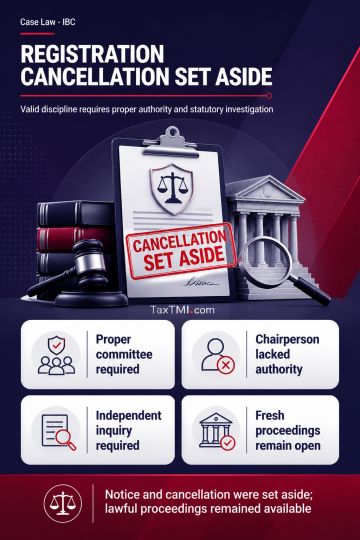
Disciplinary Committee jurisdiction and mandatory investigation requirements invalidated cancellation of an insolvency professional's registration and...
Retention of seized property survives where recorded reasons support proceeds of crime, while stayed investigation periods are excluded from limitatio...
Specified income of Baddi Barotiwala Nalagarh Development Authority receives conditional tax exemption, retrospectively covering its designated assess...
Page of 4817
Press 'Enter' after typing page number.
1461 to 1480 of 96332 Results
❮
❯
❯❯
0 / 200
Expand Note
Add to Folder
No Folders have been created
+
Are you sure you want to delete "My most important" ?
For section 80-IA, the market value of captive power had to be benchmarked to the tariff charged by the State Electricity Board to industrial consumers, including the electricity duty component, and not to the assessee's sale price for surplus power; the assessee therefore succeeded on quantification. Deduction under section 80-IA did not require any reduction from profits eligible under section 80HHC, so the assessee also succeeded on that computation issue. For section 115JB, the entire profits eligible under section 80HHC had to be excluded from book profit, as the phased restriction in section 80HHC(1B) did not govern MAT computation. Applying the purpose test, sales tax remission linked to industrial expansion in backward areas was held to be a capital receipt and excludible from book profit.
For section 80-IA, the market value of captive power had to be benchmarked to the tariff charged by the State Electricity Board to industrial consumers, including the electricity duty component, and not to the assessee's sale price for surplus power; the assessee therefore succeeded on quantification. Deduction under section 80-IA did not require any reduction from profits eligible under section 80HHC, so the assessee also succeeded on that computation issue. For section 115JB, the entire profits eligible under section 80HHC had to be excluded from book profit, as the phased restriction in section 80HHC(1B) did not govern MAT computation. Applying the purpose test, sales tax remission linked to industrial expansion in backward areas was held to be a capital receipt and excludible from book profit.
Note: It is a system-generated summary and is for quick reference only.
 TaxTMI
  TaxTMI
 of 4817












 Join Channel