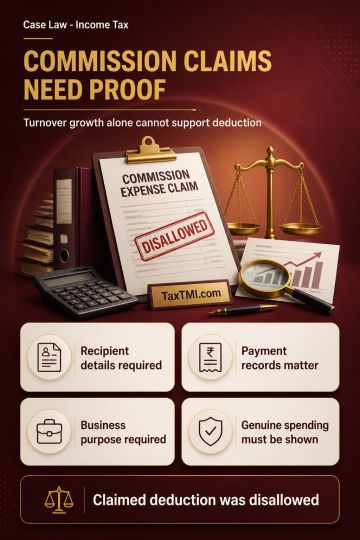
Business expenditure deduction requires proof of genuine commission payments and commercial allowability; turnover growth alone cannot validate the cl...
Article 8 treaty coverage excluded third-party airline support services, while documented demonetisation cash receipts remained accepted business inco...
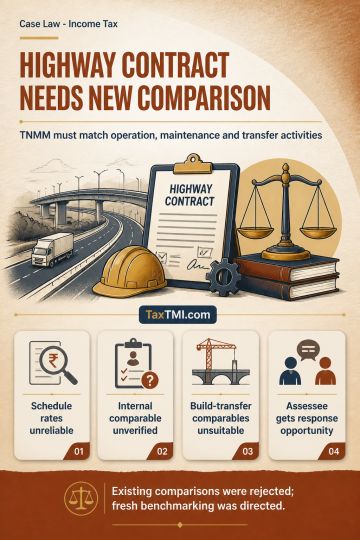
Functional comparability under TNMM requires highway contract benchmarks to reflect operation, maintenance and transfer activities, requiring fresh be...
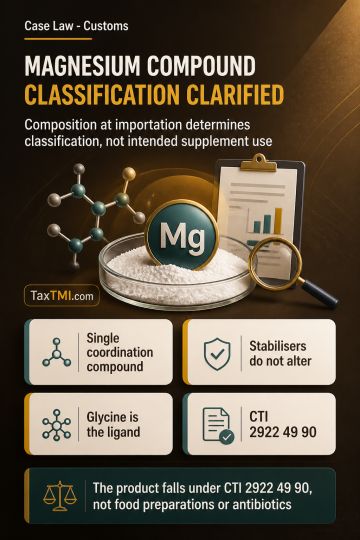
Objective characteristics govern magnesium bis-glycinate chelate classification as an amino-acid coordination compound, not a food preparation or anti...
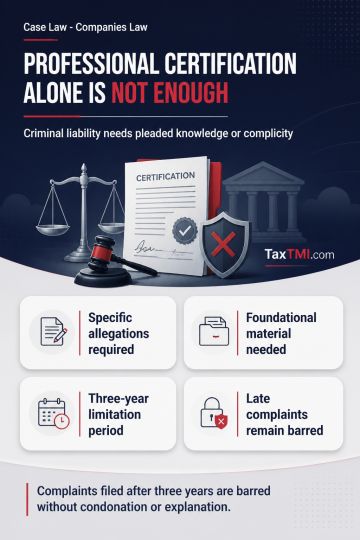
Independent professional certification requires pleaded knowledge or complicity for criminal liability; untimely complaints remain barred by limitatio...
Page of 4819
Press 'Enter' after typing page number.
901 to 920 of 96365 Results
❮
❯
❯❯
0 / 200
Expand Note
Add to Folder
No Folders have been created
+
Are you sure you want to delete "My most important" ?
For section 80-IA, the market value of captive power had to be benchmarked to the tariff charged by the State Electricity Board to industrial consumers, including the electricity duty component, and not to the assessee's sale price for surplus power; the assessee therefore succeeded on quantification. Deduction under section 80-IA did not require any reduction from profits eligible under section 80HHC, so the assessee also succeeded on that computation issue. For section 115JB, the entire profits eligible under section 80HHC had to be excluded from book profit, as the phased restriction in section 80HHC(1B) did not govern MAT computation. Applying the purpose test, sales tax remission linked to industrial expansion in backward areas was held to be a capital receipt and excludible from book profit.
For section 80-IA, the market value of captive power had to be benchmarked to the tariff charged by the State Electricity Board to industrial consumers, including the electricity duty component, and not to the assessee's sale price for surplus power; the assessee therefore succeeded on quantification. Deduction under section 80-IA did not require any reduction from profits eligible under section 80HHC, so the assessee also succeeded on that computation issue. For section 115JB, the entire profits eligible under section 80HHC had to be excluded from book profit, as the phased restriction in section 80HHC(1B) did not govern MAT computation. Applying the purpose test, sales tax remission linked to industrial expansion in backward areas was held to be a capital receipt and excludible from book profit.
Note: It is a system-generated summary and is for quick reference only.
 TaxTMI
  TaxTMI
 of 4819





 Join Channel


