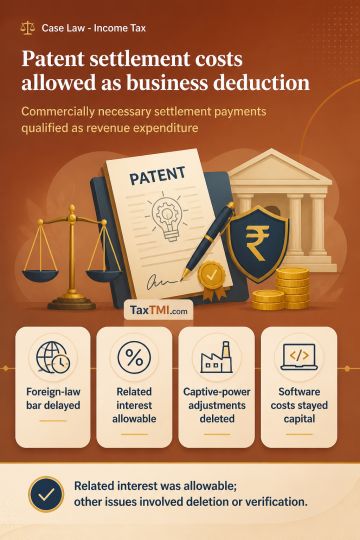
Patent-settlement expenditure treated as commercially expedient revenue outlay, with foreign-law restrictions inapplicable before the prospective amen...
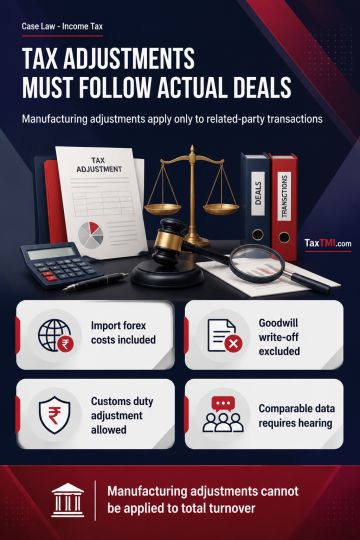
International transaction benchmarking restricts transfer pricing adjustments to associated-enterprise dealings, while functional comparability govern...
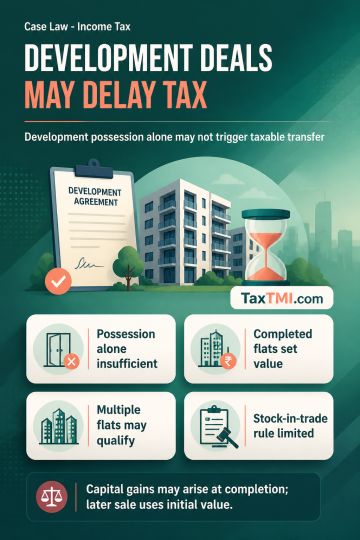
Joint development agreements defer taxable transfer where possession lacks part performance, while completed flats determine consideration and exempti...
Passenger baggage re-export requires true declaration and cannot be granted indirectly through discretionary redemption of undeclared prohibited goods...
Page of 4821
Press 'Enter' after typing page number.
861 to 880 of 96406 Results
❮
❯
❯❯
0 / 200
Expand Note
Add to Folder
No Folders have been created
+
Are you sure you want to delete "My most important" ?
For section 80-IA, the market value of captive power had to be benchmarked to the tariff charged by the State Electricity Board to industrial consumers, including the electricity duty component, and not to the assessee's sale price for surplus power; the assessee therefore succeeded on quantification. Deduction under section 80-IA did not require any reduction from profits eligible under section 80HHC, so the assessee also succeeded on that computation issue. For section 115JB, the entire profits eligible under section 80HHC had to be excluded from book profit, as the phased restriction in section 80HHC(1B) did not govern MAT computation. Applying the purpose test, sales tax remission linked to industrial expansion in backward areas was held to be a capital receipt and excludible from book profit.
For section 80-IA, the market value of captive power had to be benchmarked to the tariff charged by the State Electricity Board to industrial consumers, including the electricity duty component, and not to the assessee's sale price for surplus power; the assessee therefore succeeded on quantification. Deduction under section 80-IA did not require any reduction from profits eligible under section 80HHC, so the assessee also succeeded on that computation issue. For section 115JB, the entire profits eligible under section 80HHC had to be excluded from book profit, as the phased restriction in section 80HHC(1B) did not govern MAT computation. Applying the purpose test, sales tax remission linked to industrial expansion in backward areas was held to be a capital receipt and excludible from book profit.
Note: It is a system-generated summary and is for quick reference only.
 TaxTMI
  TaxTMI
 of 4821




 Join Channel