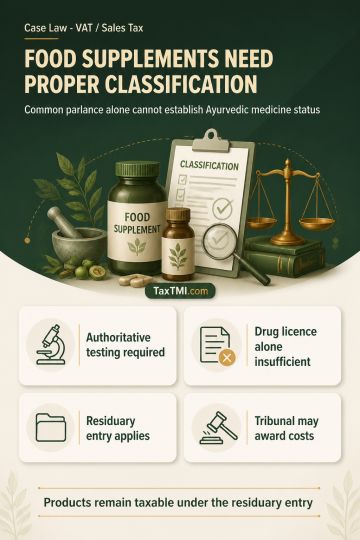
Food supplement classification requires common parlance and authoritative tests, preventing treatment as proprietary Ayurvedic medicines without suppo...
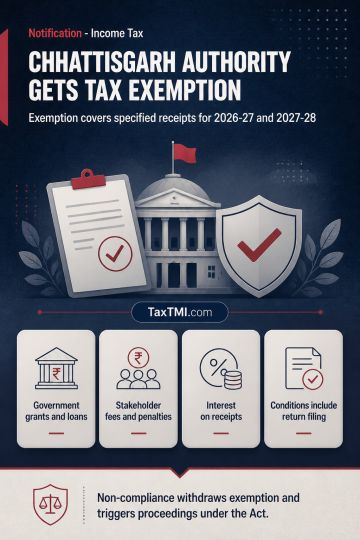
Specified regulatory authority income receives conditional tax exemption, subject to non-commercial activity, unchanged income character, and return f...
Tax exemption for regulatory authority income applies retrospectively, subject to non-commercial activity, unchanged income sources, and return-filing...
Input tax credit conditions remain constitutionally valid, with eligible recipient claims considered under GST circulars and retrospective filing dead...
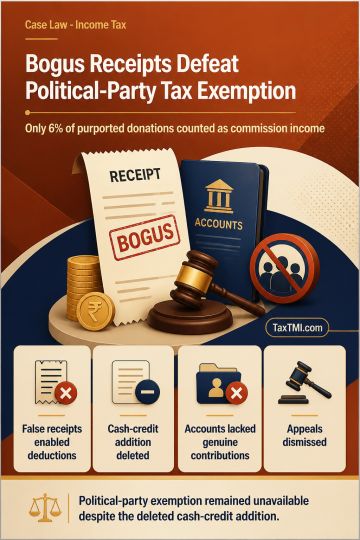
Bogus donation receipts justified commission income assessment and defeated political-party tax exemption for inaccurate accounts and reporting failur...
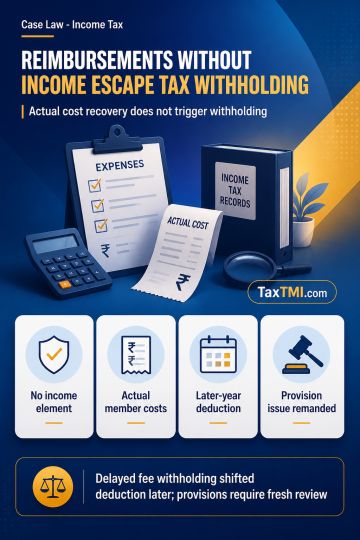
Pure reimbursement without income element escapes tax withholding, while delayed withholding and unsupported provisions face deferred or renewed scrut...
Page of 4819
Press 'Enter' after typing page number.
1061 to 1080 of 96365 Results
❮
❯
❯❯
0 / 200
Expand Note
Add to Folder
No Folders have been created
+
Are you sure you want to delete "My most important" ?
Section 251(1) enhancement power was confined to matters or sources of income considered by the Assessing Officer; the CIT(A) could not introduce a fresh issue by reducing work-in-progress on a point never examined in assessment, so the enhancement was invalid and reversed. Receipts under the joint development arrangement were treated as security deposits and business receipts, not loans or advances, and deemed dividend under section 2(22)(e) could be taxed only in the hands of a shareholder; as the assessee was neither a registered nor beneficial shareholder, the addition was deleted. For the joint development agreement, the asset was stock-in-trade and income had to be measured by the consideration actually receivable under the arrangement, not by stamp duty value of the entire land parcel, so the protective addition for alleged extra consideration was affirmed as deleted.
Section 251(1) enhancement power was confined to matters or sources of income considered by the Assessing Officer; the CIT(A) could not introduce a fresh issue by reducing work-in-progress on a point never examined in assessment, so the enhancement was invalid and reversed. Receipts under the joint development arrangement were treated as security deposits and business receipts, not loans or advances, and deemed dividend under section 2(22)(e) could be taxed only in the hands of a shareholder; as the assessee was neither a registered nor beneficial shareholder, the addition was deleted. For the joint development agreement, the asset was stock-in-trade and income had to be measured by the consideration actually receivable under the arrangement, not by stamp duty value of the entire land parcel, so the protective addition for alleged extra consideration was affirmed as deleted.
Note: It is a system-generated summary and is for quick reference only.
 TaxTMI
  TaxTMI
 of 4819
















 Join Channel