Toy balloon tariff classification: functional heading prevails over residual rubber and festive article headings, supporting penalties for deliberate ...
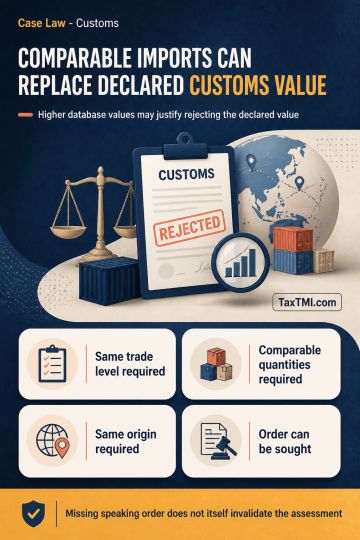
Customs valuation using comparable contemporaneous imports can displace declared value, while missing speaking orders require pursuit before competent...
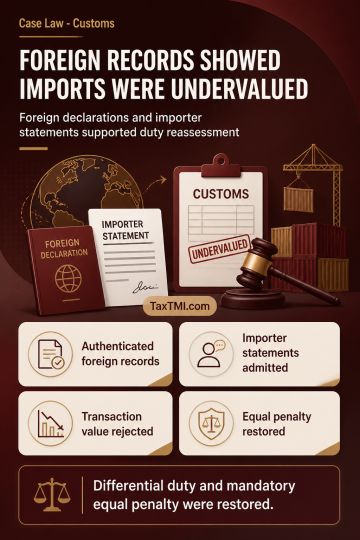
Foreign customs declarations and importer admissions established undervaluation, supporting sequential value redetermination, differential duty, and m...
Customs seizure safeguards prevent detention-based limitation avoidance and invalidate provisional release conditions for imported vehicles under an i...
Page of 4828
Press 'Enter' after typing page number.
361 to 380 of 96556 Results
❮
❯
❯❯
0 / 200
Expand Note
Add to Folder
No Folders have been created
+
Are you sure you want to delete "My most important" ?
Section 251(1) enhancement power was confined to matters or sources of income considered by the Assessing Officer; the CIT(A) could not introduce a fresh issue by reducing work-in-progress on a point never examined in assessment, so the enhancement was invalid and reversed. Receipts under the joint development arrangement were treated as security deposits and business receipts, not loans or advances, and deemed dividend under section 2(22)(e) could be taxed only in the hands of a shareholder; as the assessee was neither a registered nor beneficial shareholder, the addition was deleted. For the joint development agreement, the asset was stock-in-trade and income had to be measured by the consideration actually receivable under the arrangement, not by stamp duty value of the entire land parcel, so the protective addition for alleged extra consideration was affirmed as deleted.
Section 251(1) enhancement power was confined to matters or sources of income considered by the Assessing Officer; the CIT(A) could not introduce a fresh issue by reducing work-in-progress on a point never examined in assessment, so the enhancement was invalid and reversed. Receipts under the joint development arrangement were treated as security deposits and business receipts, not loans or advances, and deemed dividend under section 2(22)(e) could be taxed only in the hands of a shareholder; as the assessee was neither a registered nor beneficial shareholder, the addition was deleted. For the joint development agreement, the asset was stock-in-trade and income had to be measured by the consideration actually receivable under the arrangement, not by stamp duty value of the entire land parcel, so the protective addition for alleged extra consideration was affirmed as deleted.
Note: It is a system-generated summary and is for quick reference only.
 TaxTMI
  TaxTMI
 of 4828















 Join Channel