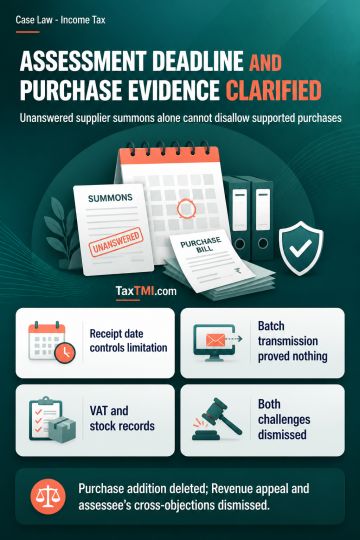
Limitation for consequential assessments runs from prescribed authority receipt, while verified purchases cannot be disallowed merely for unanswered s...
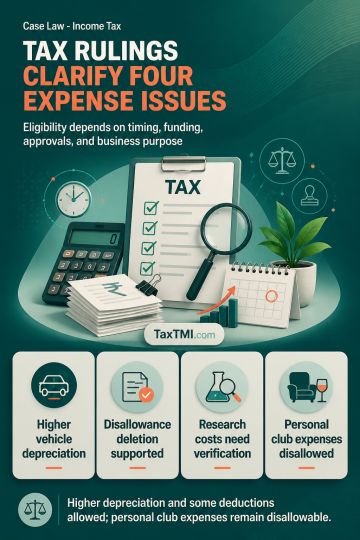
Higher depreciation for qualifying commercial vehicles, exempt-income disallowance, research deduction verification, and club-expense treatment clarif...
Charitable registration renewal cannot become an assessment of receipts, profitability or annual exemption compliance, requiring renewal and donation ...
AMP expenditure for own business is not an international transaction without an associated-enterprise arrangement, eliminating transfer pricing adjust...
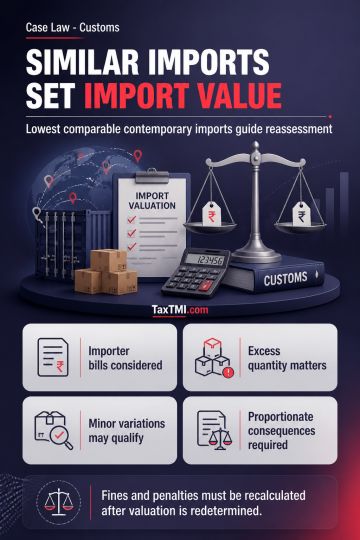
Customs valuation must use comparable contemporary imports, while confiscation fines and penalties require proportionate recalculation on reassessed v...
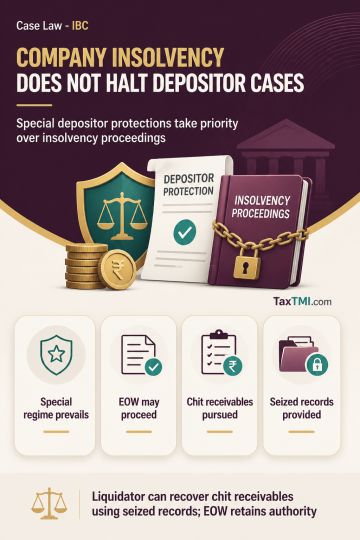
Depositor-protection proceedings prevail over corporate insolvency, while liquidators may recover chit receivables using copies of seized company reco...
Seized drone components were not shown on the record to constitute complete drones imported in CKD/SKD condition, as the quantities were uneven, imports were spread across multiple Bills of Entry, some parts were domestically procured, and the engineering report was inconclusive. Applying the principle that CKD/SKD treatment requires proof of complete units dismantled for reassembly, and that Customs Tariff interpretation rules cannot be used to read Foreign Trade Policy conditions, the Tribunal rejected the prohibition basis for refusal of provisional release. It also found no factual foundation for invoking public safety or national security, and held that the CBIC circular could not override the statutory scheme. Conditional provisional release was therefore directed.
Seized drone components were not shown on the record to constitute complete drones imported in CKD/SKD condition, as the quantities were uneven, imports were spread across multiple Bills of Entry, some parts were domestically procured, and the engineering report was inconclusive. Applying the principle that CKD/SKD treatment requires proof of complete units dismantled for reassembly, and that Customs Tariff interpretation rules cannot be used to read Foreign Trade Policy conditions, the Tribunal rejected the prohibition basis for refusal of provisional release. It also found no factual foundation for invoking public safety or national security, and held that the CBIC circular could not override the statutory scheme. Conditional provisional release was therefore directed.
Note: It is a system-generated summary and is for quick reference only.
 TaxTMI
  TaxTMI
 of 4821








 Join Channel