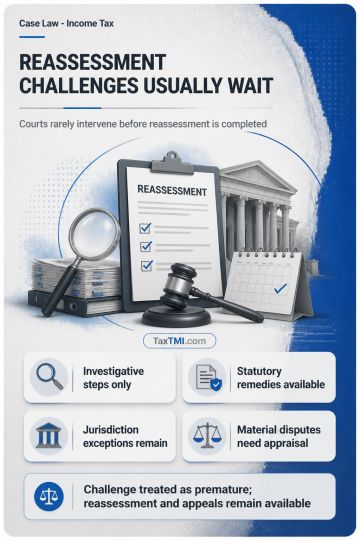
Preliminary reassessment proceedings generally require statutory remedies unless jurisdiction is wholly absent or mandatory conditions are patently br...
Agricultural land classification requires cumulative factual indicators, while industrial-purpose land and absent agricultural use defeat reinvestment...
An advance ruling under the GST law is binding on the applicant, but that binding effect does not bar High Court review under Article 226 on limited grounds such as jurisdictional error, error of law, breach of natural justice or perversity; such challenges to advance rulings should be listed before the Division Bench, not a Single Judge. On classification, the Court held that retaining the impugned view on cut tobacco would create unequal tax treatment for similarly placed manufacturers producing the same product, contrary to the equality principle. The advance rulings and the challenged order were set aside, and the writ appeal was allowed.
An advance ruling under the GST law is binding on the applicant, but that binding effect does not bar High Court review under Article 226 on limited grounds such as jurisdictional error, error of law, breach of natural justice or perversity; such challenges to advance rulings should be listed before the Division Bench, not a Single Judge. On classification, the Court held that retaining the impugned view on cut tobacco would create unequal tax treatment for similarly placed manufacturers producing the same product, contrary to the equality principle. The advance rulings and the challenged order were set aside, and the writ appeal was allowed.
Note: It is a system-generated summary and is for quick reference only.
 TaxTMI
  TaxTMI
 of 4823


















 Join Channel


