Food supplement classification requires common parlance and authoritative tests, preventing treatment as proprietary Ayurvedic medicines without suppo...
Specified regulatory authority income receives conditional tax exemption, subject to non-commercial activity, unchanged income character, and return f...
Tax exemption for regulatory authority income applies retrospectively, subject to non-commercial activity, unchanged income sources, and return-filing...
Input tax credit conditions remain constitutionally valid, with eligible recipient claims considered under GST circulars and retrospective filing dead...
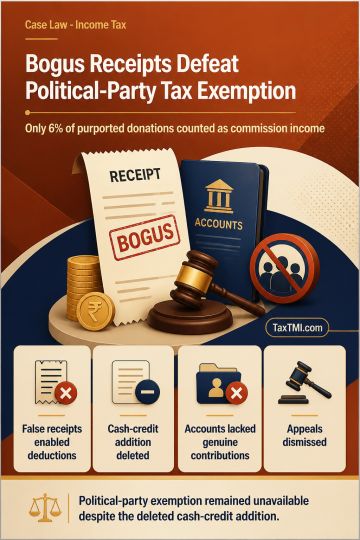
Bogus donation receipts justified commission income assessment and defeated political-party tax exemption for inaccurate accounts and reporting failur...
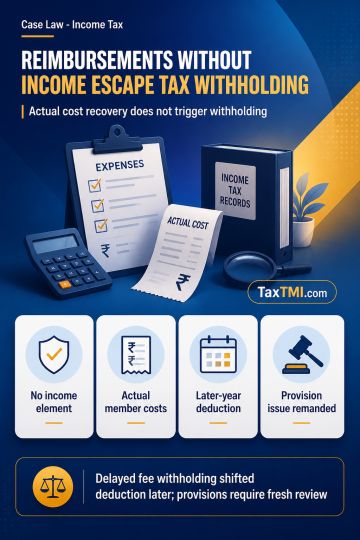
Pure reimbursement without income element escapes tax withholding, while delayed withholding and unsupported provisions face deferred or renewed scrut...
Page of 4819
Press 'Enter' after typing page number.
1061 to 1080 of 96365 Results
❮
❯
❯❯
0 / 200
Expand Note
Add to Folder
No Folders have been created
+
Are you sure you want to delete "My most important" ?
Where liability to incur construction expenditure had already accrued under the business transaction, the Court applied the mercantile system and the Calcutta Company principle to allow deduction of the estimated expense on accrual basis; the concurrent finding permitting the construction deduction was upheld. In the sale-and-lease-back arrangement involving cinematographic rights, title had passed to the assessee and the vendor thereafter remained only as lessee; mere tax-saving motive, unsupported by material, did not make the transaction a colourable device. Depreciation on the films was therefore allowed, and the Revenue failed on both issues.
Where liability to incur construction expenditure had already accrued under the business transaction, the Court applied the mercantile system and the Calcutta Company principle to allow deduction of the estimated expense on accrual basis; the concurrent finding permitting the construction deduction was upheld. In the sale-and-lease-back arrangement involving cinematographic rights, title had passed to the assessee and the vendor thereafter remained only as lessee; mere tax-saving motive, unsupported by material, did not make the transaction a colourable device. Depreciation on the films was therefore allowed, and the Revenue failed on both issues.
Note: It is a system-generated summary and is for quick reference only.
 TaxTMI
  TaxTMI
 of 4819

















 Join Channel