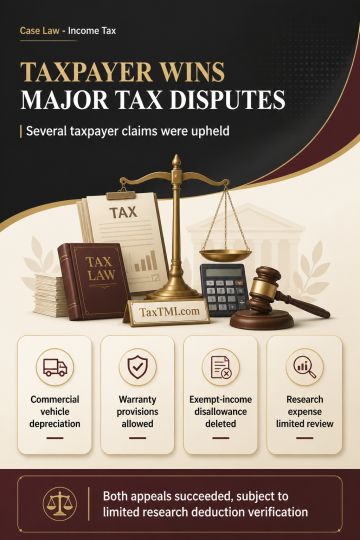
Commercial vehicle depreciation, scientifically determined warranty provisions and exempt-income disallowances were resolved in favour of the taxpayer...
Inherited property sale proceeds require capital-gains treatment where ownership is supported by evidence, not suspicion or unverified signature doubt...
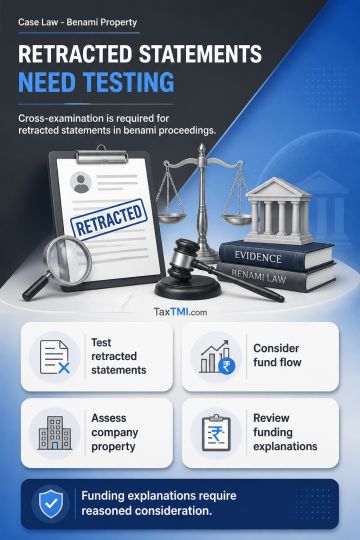
Cross-examination of retracted statements is essential where foundational evidence supports a benami allegation and documented funding explanations re...
Capital-goods exemption covers plant-modernisation accessories, while the import restriction applies only to earlier capital-goods components and spar...
Page of 4819
Press 'Enter' after typing page number.
781 to 800 of 96365 Results
❮
❯
❯❯
0 / 200
Expand Note
Add to Folder
No Folders have been created
+
Are you sure you want to delete "My most important" ?
Writ jurisdiction may be exercised against show cause notices...
Writ relief against show cause notices is available where jurisdiction is absent and concluded advance rulings cannot be reopened without fresh fraud evidence.
Contents
Summary
Note
Bookmark
Share
✓ Copied successfully !
Print
Print Options
For full text, please login
Login to TaxTMI
Verification Pending
The Email Id has not been verified. Click on the link we have sent on
Writ jurisdiction may be exercised against show cause notices where the notice is alleged to be without jurisdiction, pre-determined, or abusive, even if alternative statutory remedies exist. The Court treated the challenge as one to the very assumption of power and rejected objections of prematurity and disputed facts. It further held that advance rulings are binding on the applicant and jurisdictional officer unless law or facts change, and that reopening the same issues requires fresh material showing fraud, wilful misstatement, or suppression. As no such material existed and the earlier adjudication had attained finality, the notices under the GST and excise laws were held to be without jurisdiction and quashed.
Writ jurisdiction may be exercised against show cause notices where the notice is alleged to be without jurisdiction, pre-determined, or abusive, even if alternative statutory remedies exist. The Court treated the challenge as one to the very assumption of power and rejected objections of prematurity and disputed facts. It further held that advance rulings are binding on the applicant and jurisdictional officer unless law or facts change, and that reopening the same issues requires fresh material showing fraud, wilful misstatement, or suppression. As no such material existed and the earlier adjudication had attained finality, the notices under the GST and excise laws were held to be without jurisdiction and quashed.
Note: It is a system-generated summary and is for quick reference only.
 TaxTMI
  TaxTMI
 of 4819











 Join Channel