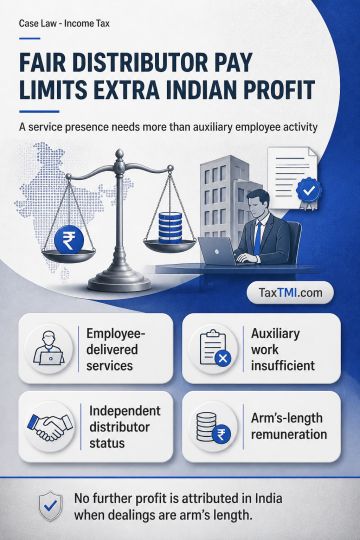
Service permanent establishment requires non-auxiliary services, while arm's-length distributor remuneration precludes further profit attribution in I...
Make-available condition excludes standard SaaS subscription receipts where customers receive no independently usable technical knowledge after subscr...
Anonymous donation classification fails where charitable trusts maintain undisputed donor identity records and evidence corpus contributions' intended...
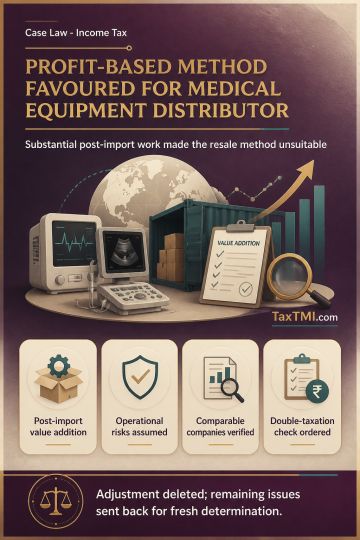
Transfer pricing method selection favours TNMM where medical-equipment distribution involves substantial post-import value addition and operational ri...
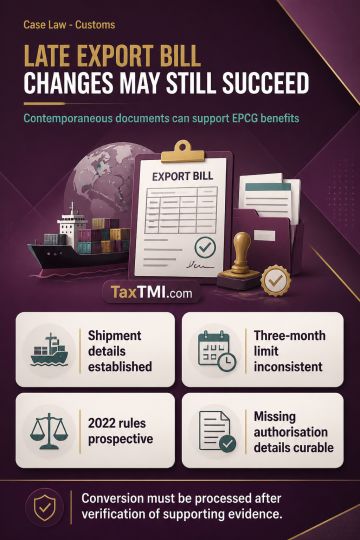
Post-export shipping bill conversion remains available where contemporaneous evidence supports EPCG benefits despite curable procedural omissions and ...
Writ jurisdiction may be exercised against show cause notices...
Writ relief against show cause notices is available where jurisdiction is absent and concluded advance rulings cannot be reopened without fresh fraud evidence.
Contents
Summary
Note
Bookmark
Share
✓ Copied successfully !
Print
Print Options
For full text, please login
Login to TaxTMI
Verification Pending
The Email Id has not been verified. Click on the link we have sent on
Writ jurisdiction may be exercised against show cause notices where the notice is alleged to be without jurisdiction, pre-determined, or abusive, even if alternative statutory remedies exist. The Court treated the challenge as one to the very assumption of power and rejected objections of prematurity and disputed facts. It further held that advance rulings are binding on the applicant and jurisdictional officer unless law or facts change, and that reopening the same issues requires fresh material showing fraud, wilful misstatement, or suppression. As no such material existed and the earlier adjudication had attained finality, the notices under the GST and excise laws were held to be without jurisdiction and quashed.
Writ jurisdiction may be exercised against show cause notices where the notice is alleged to be without jurisdiction, pre-determined, or abusive, even if alternative statutory remedies exist. The Court treated the challenge as one to the very assumption of power and rejected objections of prematurity and disputed facts. It further held that advance rulings are binding on the applicant and jurisdictional officer unless law or facts change, and that reopening the same issues requires fresh material showing fraud, wilful misstatement, or suppression. As no such material existed and the earlier adjudication had attained finality, the notices under the GST and excise laws were held to be without jurisdiction and quashed.
Note: It is a system-generated summary and is for quick reference only.
 TaxTMI
  TaxTMI
 of 4826












 Join Channel