Charitable registration renewal cannot become an assessment of receipts, profitability or annual exemption compliance, requiring renewal and donation ...
AMP expenditure for own business is not an international transaction without an associated-enterprise arrangement, eliminating transfer pricing adjust...
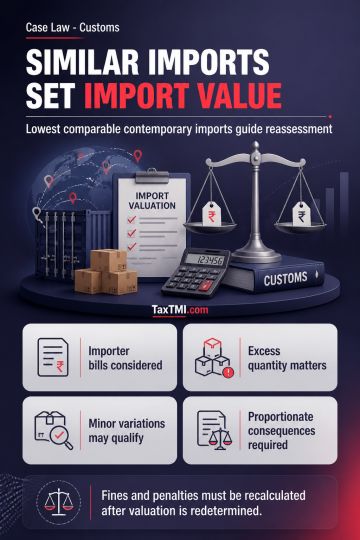
Customs valuation must use comparable contemporary imports, while confiscation fines and penalties require proportionate recalculation on reassessed v...
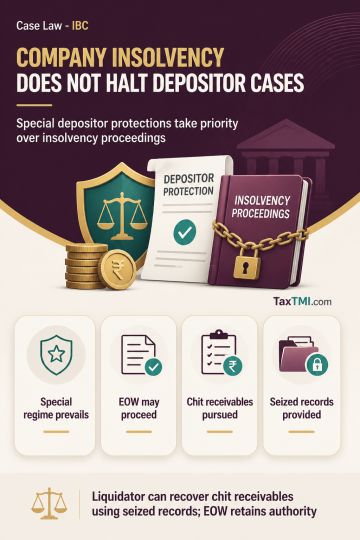
Depositor-protection proceedings prevail over corporate insolvency, while liquidators may recover chit receivables using copies of seized company reco...
Intermediary service classification fails where overseas admission facilitation is supplied independently, preserving export treatment and small-provi...
Satellite transponder bandwidth is telecommunication, not Business Support Service; foreign non-telegraph providers triggered no service tax liability...
Page of 4824
Press 'Enter' after typing page number.
441 to 460 of 96463 Results
❮
❯
❯❯
0 / 200
Expand Note
Add to Folder
No Folders have been created
+
Are you sure you want to delete "My most important" ?
Section 129(3) was held to be directory as to the seven-day timelines for issuing notice and passing the penalty order, because the statute uses procedural deadlines to secure expedition but does not make delay fatal to jurisdiction or validity. The Court rejected the view that non-compliance automatically renders detention proceedings time-barred, and found no basis to interfere on limitation where the notice was issued within seven days and the penalty order followed on the eighth day, amounting to substantial compliance. The petitioner, being a registered dealer when the transaction began, was treated as the bona fide owner and was entitled to release of the detained goods and vehicle on deposit, under protest, of an amount equal to the penalty, with liberty to challenge the penalty order separately.
Section 129(3) was held to be directory as to the seven-day timelines for issuing notice and passing the penalty order, because the statute uses procedural deadlines to secure expedition but does not make delay fatal to jurisdiction or validity. The Court rejected the view that non-compliance automatically renders detention proceedings time-barred, and found no basis to interfere on limitation where the notice was issued within seven days and the penalty order followed on the eighth day, amounting to substantial compliance. The petitioner, being a registered dealer when the transaction began, was treated as the bona fide owner and was entitled to release of the detained goods and vehicle on deposit, under protest, of an amount equal to the penalty, with liberty to challenge the penalty order separately.
Note: It is a system-generated summary and is for quick reference only.
 TaxTMI
  TaxTMI
 of 4824




















 Join Channel


