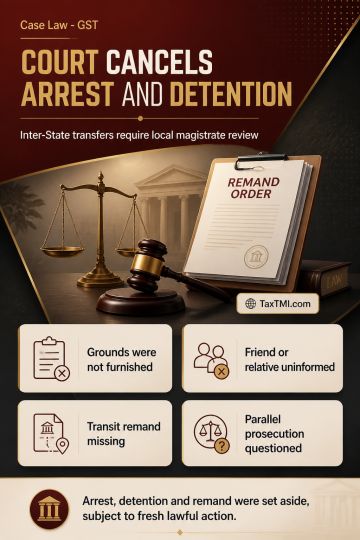
Arrest safeguards and transit remand requirements invalidated detention following inter-State transfer without communicated grounds or magistrate auth...
Arrest safeguards require disclosed grounds, relative intimation and transit remand, while duplicate prosecution under the CGST framework is unsustain...
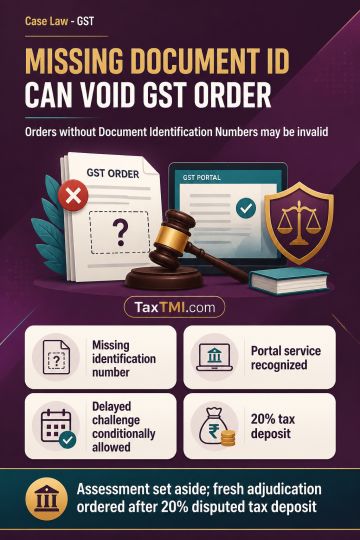
Document Identification Number defects can invalidate GST assessments, with delayed challenges entertained conditionally where patent irregularities e...
Windmill commissioning evidence supported higher depreciation where grid connection and electricity generation proved operational use before the relev...
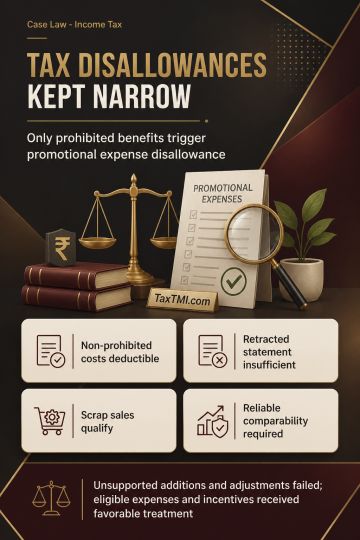
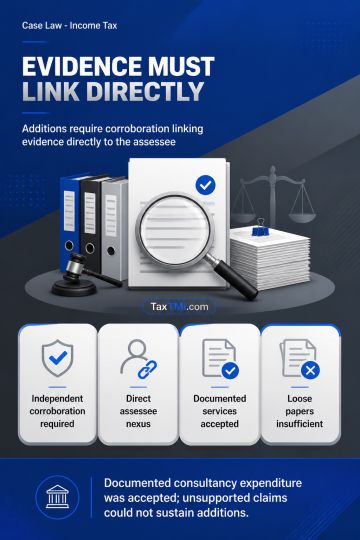
Pharmaceutical promotion and transfer-pricing comparability principles limited disallowances, while uncorroborated search allegations and unsupported ...
Business expenditure substantiation supports scrap credits, statutory payments and expense claims, while depreciation requires proof of actual busines...
The ITAT addressed multiple revenue and business expense issues, holding that advances from customers already accounted for under sale agreements or the Percentage of Completion Method could not be added again, and that notional interest on business advances or imprest could not be taxed as hypothetical income. It sustained deletion of disallowances where invoices, payment evidence, or business nexus were verified, but upheld a disallowance for advertisement expense found unrelated to business. It also held that section 14A disallowance could not survive in the absence of exempt income, and accepted prior period expenses where liability had crystallized. Certain issues on revised computation, advertisement, consultancy and withholding tax were remanded for verification, while employee accommodation commission and brokerage and write-off of advances were allowed as deductible business loss.
The ITAT addressed multiple revenue and business expense issues, holding that advances from customers already accounted for under sale agreements or the Percentage of Completion Method could not be added again, and that notional interest on business advances or imprest could not be taxed as hypothetical income. It sustained deletion of disallowances where invoices, payment evidence, or business nexus were verified, but upheld a disallowance for advertisement expense found unrelated to business. It also held that section 14A disallowance could not survive in the absence of exempt income, and accepted prior period expenses where liability had crystallized. Certain issues on revised computation, advertisement, consultancy and withholding tax were remanded for verification, while employee accommodation commission and brokerage and write-off of advances were allowed as deductible business loss.
Note: It is a system-generated summary and is for quick reference only.
 TaxTMI
  TaxTMI
 of 4817

















 Join Channel