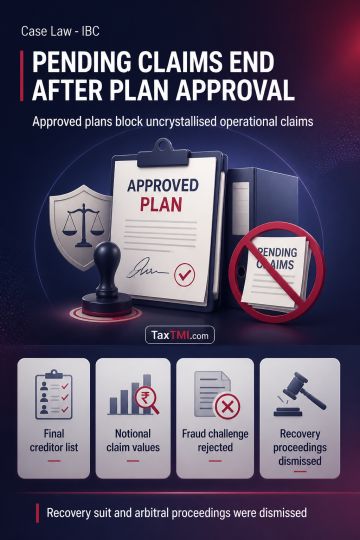
Clean slate principle extinguishes uncrystallised operational claims and bars continuation of pending recovery and arbitral proceedings after plan app...
Works contract classification governs composite layout-development contracts where VAT-paid goods are transferred alongside construction and infrastru...
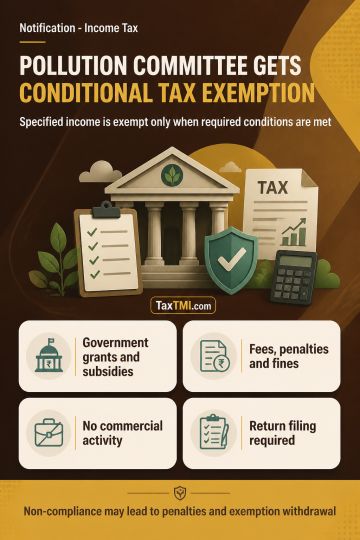
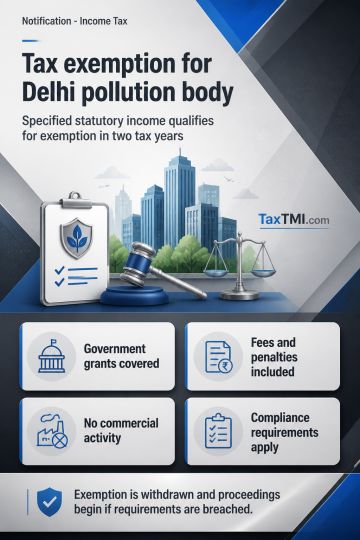
Specified income tax exemption for pollution control body remains conditional on non-commercial activity, unchanged income character, and return filin...
Jurisdictional facts in certificate-of-origin discrepancies can support customs show-cause proceedings, leaving factual explanations for departmental ...
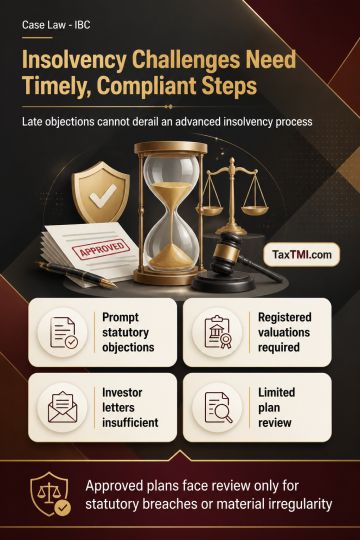
Section 65 of the IBC permits termination of CIRP where initiation is shown to be fraudulent or malicious, but only on specific pleadings and supporting material. The NCLAT held that the provision can be invoked even after a Section 7 admission order attains finality, yet it cannot be used to reopen the earlier finding on debt and default. On the facts, the bank relied on the same assignment-based contention already considered in the Section 7 proceedings, and the record did not show collusion, fraud or malicious intent. The forensic audit direction was also set aside because no such relief had been sought and it was unnecessary once Section 65 relief was refused.
Section 65 of the IBC permits termination of CIRP where initiation is shown to be fraudulent or malicious, but only on specific pleadings and supporting material. The NCLAT held that the provision can be invoked even after a Section 7 admission order attains finality, yet it cannot be used to reopen the earlier finding on debt and default. On the facts, the bank relied on the same assignment-based contention already considered in the Section 7 proceedings, and the record did not show collusion, fraud or malicious intent. The forensic audit direction was also set aside because no such relief had been sought and it was unnecessary once Section 65 relief was refused.
Note: It is a system-generated summary and is for quick reference only.
 TaxTMI
  TaxTMI
 of 4817









 Join Channel