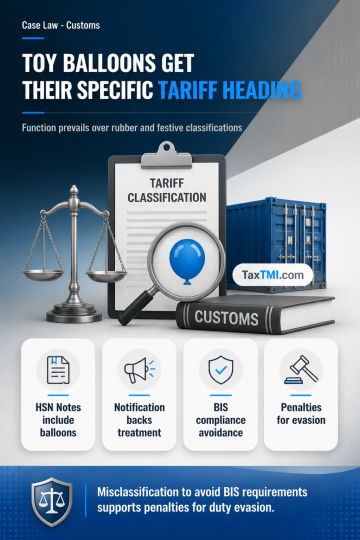
Toy balloon tariff classification: functional heading prevails over residual rubber and festive article headings, supporting penalties for deliberate ...
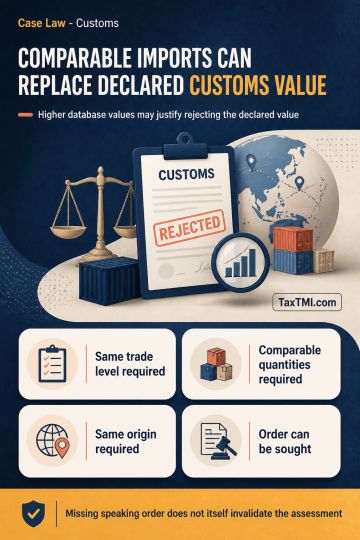
Customs valuation using comparable contemporaneous imports can displace declared value, while missing speaking orders require pursuit before competent...
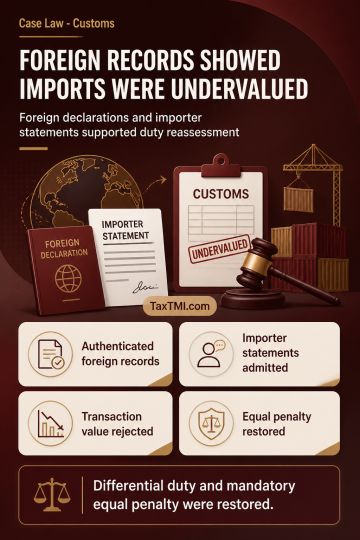
Foreign customs declarations and importer admissions established undervaluation, supporting sequential value redetermination, differential duty, and m...
Customs seizure safeguards prevent detention-based limitation avoidance and invalidate provisional release conditions for imported vehicles under an i...
Page of 4828
Press 'Enter' after typing page number.
361 to 380 of 96556 Results
❮
❯
❯❯
0 / 200
Expand Note
Add to Folder
No Folders have been created
+
Are you sure you want to delete "My most important" ?
Software expenditure was held to require a year-specific functional test: software forming part of the profit-making apparatus and enhancing system capacity or functionality was treated as capital expenditure with depreciation allowable, while routine subscription-based software was allowed as revenue expenditure. Section 14A disallowance was confined by applying the presumption that investments were made out of own funds where interest-free funds exceeded investments, and Rule 8D(2)(iii) was restricted to investments that actually yielded exempt income; no MAT addition followed where there was no disallowance under Rule 8D(2)(i). Debenture Redemption Reserve was held to be a provision for a known liability set apart for debenture redemption, not an unascertained reserve, and was excluded from book profit under section 115JB.
Software expenditure was held to require a year-specific functional test: software forming part of the profit-making apparatus and enhancing system capacity or functionality was treated as capital expenditure with depreciation allowable, while routine subscription-based software was allowed as revenue expenditure. Section 14A disallowance was confined by applying the presumption that investments were made out of own funds where interest-free funds exceeded investments, and Rule 8D(2)(iii) was restricted to investments that actually yielded exempt income; no MAT addition followed where there was no disallowance under Rule 8D(2)(i). Debenture Redemption Reserve was held to be a provision for a known liability set apart for debenture redemption, not an unascertained reserve, and was excluded from book profit under section 115JB.
Note: It is a system-generated summary and is for quick reference only.
 TaxTMI
  TaxTMI
 of 4828





 Join Channel