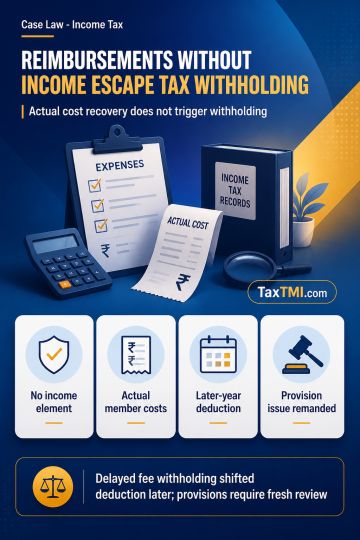
Pure reimbursement without income element escapes tax withholding, while delayed withholding and unsupported provisions face deferred or renewed scrut...
Public benefit requirement defeats charitable registration where residents' association services are reciprocal, member-only facilities governed by mu...
Exempt-income expenditure disallowance is confined to investments that actually generated exempt income, while supported business expenses remain dedu...
Objective characteristics and principal use govern mining-tyre classification, while fresh advance ruling applications may rely on additional technica...
The ITAT held that penalty under section 271(1)(c) was unsustainable because the dispute concerned only the head of income and the allowability of deduction on disclosed facts, not concealment or furnishing of inaccurate particulars. The assessee's claim for full section 54 relief was accepted on the merits, and the joint reinvestment with her son had been disclosed to the department. Relying on Manjunatha Cotton and Reliance Petroproducts, the Tribunal held that a disallowed claim or a claim under a different head does not by itself justify penalty. The penalty was deleted.
The ITAT held that penalty under section 271(1)(c) was unsustainable because the dispute concerned only the head of income and the allowability of deduction on disclosed facts, not concealment or furnishing of inaccurate particulars. The assessee's claim for full section 54 relief was accepted on the merits, and the joint reinvestment with her son had been disclosed to the department. Relying on Manjunatha Cotton and Reliance Petroproducts, the Tribunal held that a disallowed claim or a claim under a different head does not by itself justify penalty. The penalty was deleted.
Note: It is a system-generated summary and is for quick reference only.
 TaxTMI
  TaxTMI
 of 4821















 Join Channel


