Business expenditure deduction requires proof of genuine commission payments and commercial allowability; turnover growth alone cannot validate the cl...
Article 8 treaty coverage excluded third-party airline support services, while documented demonetisation cash receipts remained accepted business inco...
Functional comparability under TNMM requires highway contract benchmarks to reflect operation, maintenance and transfer activities, requiring fresh be...
Objective characteristics govern magnesium bis-glycinate chelate classification as an amino-acid coordination compound, not a food preparation or anti...
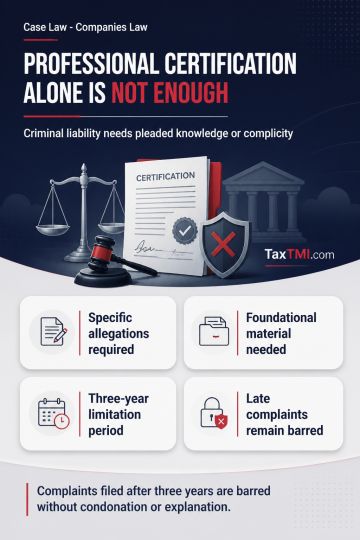
Independent professional certification requires pleaded knowledge or complicity for criminal liability; untimely complaints remain barred by limitatio...
The ITAT held that penalty under section 271(1)(c) was unsustainable because the dispute concerned only the head of income and the allowability of deduction on disclosed facts, not concealment or furnishing of inaccurate particulars. The assessee's claim for full section 54 relief was accepted on the merits, and the joint reinvestment with her son had been disclosed to the department. Relying on Manjunatha Cotton and Reliance Petroproducts, the Tribunal held that a disallowed claim or a claim under a different head does not by itself justify penalty. The penalty was deleted.
The ITAT held that penalty under section 271(1)(c) was unsustainable because the dispute concerned only the head of income and the allowability of deduction on disclosed facts, not concealment or furnishing of inaccurate particulars. The assessee's claim for full section 54 relief was accepted on the merits, and the joint reinvestment with her son had been disclosed to the department. Relying on Manjunatha Cotton and Reliance Petroproducts, the Tribunal held that a disallowed claim or a claim under a different head does not by itself justify penalty. The penalty was deleted.
Note: It is a system-generated summary and is for quick reference only.
 TaxTMI
  TaxTMI
 of 4824











 Join Channel