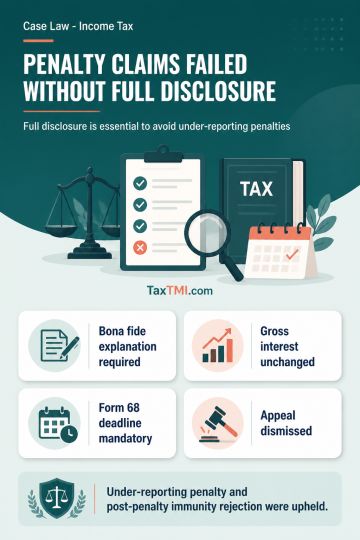
Bona fide disclosure requirements govern under-reporting penalties, and post-penalty immunity applications cannot secure available statutory protectio...
Certificate-of-origin verification procedure governs preferential customs benefits; denial without retroactive verification was set aside with consequ...
Disciplinary Committee jurisdiction and mandatory investigation requirements invalidated cancellation of an insolvency professional's registration and...
Retention of seized property survives where recorded reasons support proceeds of crime, while stayed investigation periods are excluded from limitatio...
Specified income of Baddi Barotiwala Nalagarh Development Authority receives conditional tax exemption, retrospectively covering its designated assess...
Page of 4817
Press 'Enter' after typing page number.
1461 to 1480 of 96332 Results
❮
❯
❯❯
0 / 200
Expand Note
Add to Folder
No Folders have been created
+
Are you sure you want to delete "My most important" ?
No prescribed limitation period governed petitions under the Companies Act before the Company Law Board, but unexplained delay could still matter where relief is discretionary; on these facts, the grievance concerned a continuing course of oppression and mismanagement, so delay, laches, acquiescence and estoppel did not bar scrutiny. The Board could examine fraud and forgery on the record where the material disclosed mala fide exclusion, and its findings on shareholding, clandestine meetings and oppressive conduct were not perverse under Section 10F because they rested on company records and correspondence. Additional evidence under Order XLI Rule 27 required due diligence and necessity, which were not shown. The special auditor direction was only consequential and was upheld.
No prescribed limitation period governed petitions under the Companies Act before the Company Law Board, but unexplained delay could still matter where relief is discretionary; on these facts, the grievance concerned a continuing course of oppression and mismanagement, so delay, laches, acquiescence and estoppel did not bar scrutiny. The Board could examine fraud and forgery on the record where the material disclosed mala fide exclusion, and its findings on shareholding, clandestine meetings and oppressive conduct were not perverse under Section 10F because they rested on company records and correspondence. Additional evidence under Order XLI Rule 27 required due diligence and necessity, which were not shown. The special auditor direction was only consequential and was upheld.
Note: It is a system-generated summary and is for quick reference only.
 TaxTMI
  TaxTMI
 of 4817

















 Join Channel