Business expenditure deduction requires proof of genuine commission payments and commercial allowability; turnover growth alone cannot validate the cl...
Article 8 treaty coverage excluded third-party airline support services, while documented demonetisation cash receipts remained accepted business inco...
Functional comparability under TNMM requires highway contract benchmarks to reflect operation, maintenance and transfer activities, requiring fresh be...
Objective characteristics govern magnesium bis-glycinate chelate classification as an amino-acid coordination compound, not a food preparation or anti...
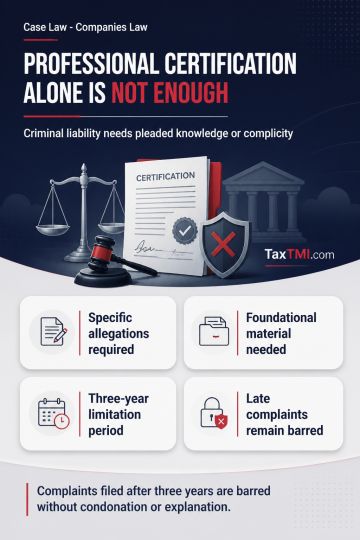
Independent professional certification requires pleaded knowledge or complicity for criminal liability; untimely complaints remain barred by limitatio...
Page of 4819
Press 'Enter' after typing page number.
901 to 920 of 96365 Results
❮
❯
❯❯
0 / 200
Expand Note
Add to Folder
No Folders have been created
+
Are you sure you want to delete "My most important" ?
No prescribed limitation period governed petitions under the Companies Act before the Company Law Board, but unexplained delay could still matter where relief is discretionary; on these facts, the grievance concerned a continuing course of oppression and mismanagement, so delay, laches, acquiescence and estoppel did not bar scrutiny. The Board could examine fraud and forgery on the record where the material disclosed mala fide exclusion, and its findings on shareholding, clandestine meetings and oppressive conduct were not perverse under Section 10F because they rested on company records and correspondence. Additional evidence under Order XLI Rule 27 required due diligence and necessity, which were not shown. The special auditor direction was only consequential and was upheld.
No prescribed limitation period governed petitions under the Companies Act before the Company Law Board, but unexplained delay could still matter where relief is discretionary; on these facts, the grievance concerned a continuing course of oppression and mismanagement, so delay, laches, acquiescence and estoppel did not bar scrutiny. The Board could examine fraud and forgery on the record where the material disclosed mala fide exclusion, and its findings on shareholding, clandestine meetings and oppressive conduct were not perverse under Section 10F because they rested on company records and correspondence. Additional evidence under Order XLI Rule 27 required due diligence and necessity, which were not shown. The special auditor direction was only consequential and was upheld.
Note: It is a system-generated summary and is for quick reference only.
 TaxTMI
  TaxTMI
 of 4819


















 Join Channel


